
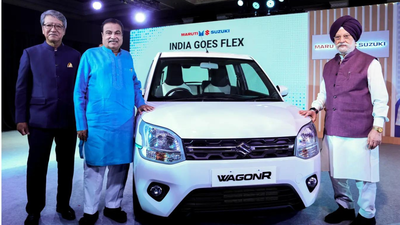
India’s push for flex-fuel vehicles can help meet twin national goals of cutting crude oil imports and reducing carbon emissions, but will require a full supporting ecosystem from fuel availability to wider model launches, Maruti Suzuki India MD and CEO Hisashi Takeuchi said on Thursday.Speaking at the launch of the company’s first flex-fuel car, Wagon R, Takeuchi said the technology offers benefits that extend beyond the automobile sector, supporting farmers, ethanol producers and the wider rural economy.
What is a flex-fuel vehicle?
A flex-fuel vehicle is an internal combustion engine vehicle designed to run on multiple fuel blends, typically a mix of petrol and ethanol (or methanol), with the ability to operate across a wide range of ethanol content such as E20 to E100.This allows the same vehicle to run on conventional petrol or nearly pure biofuel depending on availability.
‘Flex-fuel meets both national objectives’
Takeuchi said India stands at a critical juncture, recalling Prime Minister Narendra Modi’s appeal to reduce fuel consumption and import dependence, while also advancing towards self-reliance and Viksit Bharat by 2047.He said energy security at scale and speed is essential and argued that long-term dependence on imported crude oil is not viable.“Flex-fuel meets both. It is truly Atmanirbhar and clean,” he said, adding that it supports both import reduction and emissions cuts, as per news agency PTI.
Ecosystem needed for large-scale rollout
Takeuchi stressed that mass adoption would take time and coordination across stakeholders, including fuel availability, pricing, infrastructure and customer awareness.He said Maruti Suzuki is taking the first major step with the Wagon R flex-fuel launch and urged oil marketing companies and ethanol producers to join the effort.The company also highlighted its broader multi-pathway strategy, including EVs, strong hybrids and CNG, along with investments in compressed biogas projects.
Government pushes biofuel transition
At the launch event, Union minister Nitin Gadkari said India could shift from being an energy-importing nation to an energy exporter, citing progress in ethanol, hydrogen and sustainable aviation fuel.He said India spends about Rs 22 lakh crore annually on fuel imports and called clean energy adoption essential to reduce both economic burden and pollution.Gadkari also said ethanol production from corn has significantly increased farmer income, while hydrogen and green mobility projects are being expanded across selected highway corridors.
Fuel transition and infrastructure push
Petroleum minister Hardeep Singh Puri said India is rolling out 50–100 ethanol fuel stations across major cities, with plans to expand to 500 by 2026 and 5,000 by 2027.He said ethanol blending has already reached 20 per cent, helping reduce crude imports and save foreign exchange, while also boosting rural incomes.Officials said the broader push toward flex-fuel and biofuels aims to strengthen energy security, support agricultural value chains, and reduce emissions.