
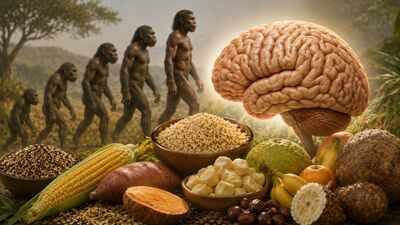
For decades, the story of human brain evolution has centred on meat. Increasing consumption of animal protein and fat has long been credited with powering the dramatic growth of the human brain over four million years. According to the new study published in Science, titled ‘A central role for dietary sugars in human evolution’, researchers modelled the macronutrient requirements of hominins across their evolutionary history and found that dietary sugars, not animal foods alone, played a decisive role in fuelling brain development. Glucose from fruit and honey, and later from cooked starch, appears essential to meeting the brain’s heavy energy demands. The focus of human dietary evolution shifts, then, towards carbohydrates as much as protein.
Why glucose was essential for human brain evolution
The human brain is an expensive organ to run. It makes up only around 2% of adult body weight, yet it consumes roughly 20% of the body’s basal metabolic rate, a figure that climbs to 66% in a five-year-old child. The brain runs mainly on glucose, and while the body can make glucose from other sources such as amino acids, that process is slow and limited.This demand grew as hominin brain size expanded, from around 300 grams in Australopithecus afarensis to roughly 1,500 grams in modern Homo sapiens. Researchers calculated that meeting it required a steady dietary source of glucose, one that meat alone could not easily supply, particularly before fire was mastered.
How researchers modelled dietary carbohydrates in human evolution
Researchers built a model comparing dietary carbohydrate availability against obligatory glucose demand at different points in hominin evolution. The model worked through six incremental steps based on the ratio of animal to plant foods in the diet, starting with chimpanzee-like diets and moving towards ratios seen in modern hunter-gatherer groups. The team drew on fossil isotope ratios, dental structure and genetic data to back up their calculations.Estimated glucose demand ranged from 125 grams a day in young children to as much as 250 grams a day in reproductive females. Carbohydrate availability in the diet, meanwhile, ran from 230 to 400 grams a day depending on the balance of animal and plant foods eaten.
Why fruit and cooked starch became key to human evolution
Early hominins likely leaned heavily on fruit for energy. More than 65% of their dietary energy is thought to have come from sugars in fruit and other sweet foods. That reliance would have left hominins exposed to seasonal and geographic swings in food supply, shaping how they foraged and possibly contributing to population declines when food ran short.Fire changed things. Cooking broke starch down more efficiently, turning it into a more usable source of glucose. Over time, cooked starch supplemented, and in places replaced, fruit sugars as the main carbohydrate source. At an animal-to-plant energy ratio of 35:65, researchers estimated that anatomically modern humans got around 25% of their energy from sugars and another 25% from starch, alongside 19% from protein.Physiological changes back up this carbohydrate-heavy account of evolution. According to the study, traits such as sweet taste receptors, smaller teeth and jaws, and genetic variations tied to glucose metabolism point to selection pressures driven specifically by carbohydrate intake, not animal foods alone.
What the findings mean for human brain evolution and diet
The findings do not push animal foods out of the picture, but they do put carbohydrates on more equal footing within it. The researchers argue that sugars and starches deserve more attention when looking at how early diets shaped human development, physiology and disease risk.This reframing may matter beyond archaeology. A clearer picture of the long relationship between humans and dietary carbohydrates could inform current debates around sugar and starch consumption, moving the conversation past one that has often leaned too heavily on meat and protein alone.