
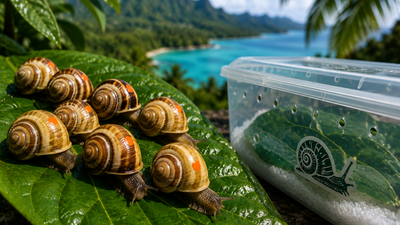
A conservation effort that began nearly four decades ago is sending hundreds of tiny snails on a remarkable journey back to their native home. Five hundred Partula snails raised at the Detroit Zoo are travelling more than 5,000 miles from Michigan to Tahiti, where they will be released into the wild as part of a long-running effort to restore populations of these endangered native snails. According to the Detroit Zoological Society, the latest shipment is part of an international conservation program that has returned more than 17,000 Partula snails to their native islands. The Detroit Zoo has been involved in the effort since 1989, helping breed and care for the snails after invasive predators caused their populations to collapse in the wild. The broader program has helped return 11 Partula species that were once considered extinct in the wild.
A decades-long effort
Partula snails are small, tree-dwelling mollusks native to islands in French Polynesia. Although they may seem insignificant compared with larger endangered animals, several Partula species faced a severe population collapse after an invasive predator was introduced to the islands. The predator was the rosy wolf snail, which had itself been brought to the islands in an attempt to control another invasive snail. Instead, it preyed on native Partula snails, contributing to the disappearance of several species from the wild.The crisis prompted conservationists and zoos to establish captive populations. The Detroit Zoo became involved in this work in 1989, helping breed and care for Partula snails with the eventual goal of returning them to their natural environment. That work has continued for 37 years.
500 snails head home
Five hundred adult Partula snails raised at the Detroit Zoo are beginning their journey from Royal Oak, Michigan, to Tahiti. The trip covers more than 5,000 miles, but the journey is more than simply moving captive animals from one location to another. The snails are being sent as part of a coordinated effort to rebuild populations in the forests where their species originally lived. Before leaving, each snail receives a small orange dot of animal-safe paint on its shell. The marking is designed to glow under ultraviolet light, allowing conservationists in Tahiti to distinguish the 2026 release group from snails released in previous years. A different paint colour is used for each year’s release, giving researchers a practical way to track individual release groups after they enter the wild.
From captivity to forests
For Partula nodosa, the stakes are particularly significant. The species is currently classified as Extinct in the Wild, meaning it survives under human care but does not have a known surviving wild population. Conservation breeding provides a way to prevent such species from disappearing completely. Zoos and other institutions can maintain genetically viable populations while conservationists work to create conditions for their eventual return.According to the Detroit Zoo, its conservation partners have documented wild-born offspring following earlier Partula reintroductions. Such reproduction is an important step because simply releasing captive-bred animals is not enough to establish a self-sustaining population. The animals must survive, reproduce and contribute to future generations in their native habitat.
More than 17,000 returned
The 500 snails travelling to Tahiti represent only a small part of the broader recovery program. According to the Detroit Zoological Society, more than 17,000 Partula snails have been reintroduced through the collaborative effort. The program has also returned 11 Partula species that were once considered extinct in the wild to their native islands. That figure illustrates how conservation programs can operate over long periods. Instead of producing an immediate result, captive breeding and reintroduction can require years of animal care, monitoring and repeated releases. For the Detroit Zoo, the current shipment is another stage in a program that connects its animal-care facilities in Michigan with conservation sites thousands of miles away in French Polynesia.
Protecting more than a species
The importance of Partula recovery also extends beyond biodiversity. The Detroit Zoological Society notes that Partula snails have cultural significance in Polynesia. Their distinctive shells have been associated with different islands, giving the animals a place in the region’s cultural heritage. Their return therefore represents more than restoring populations of small forest snails. It also helps reconnect native wildlife with the ecosystems and cultural landscapes where these species evolved. After 37 years of captive breeding and conservation work, the latest 500 snails are now taking another step toward that goal. Their journey from Michigan to Tahiti shows how a species that disappeared from the wild can, with sustained international cooperation, begin making its way back.