
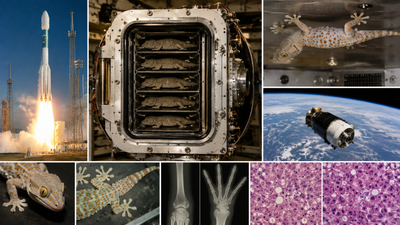
In 2005, five thick-toed geckos left Earth aboard the unmanned Russian spacecraft Foton-M2, embarking on a 16-day orbital flight with no access to food or water. The mission, a joint undertaking between Nasa and the Russian Academy of Sciences, was designed to test whether a reptile species could serve as a viable model for studying the effects of microgravity on living tissue, an area of research long dominated by rodents and amphibians. According to Nasa’s technical records, the geckos were recovered after landing and showed no apparent negative health effects; closer laboratory analysis revealed measurable changes in bone density and liver cell activity. The mission has since become a frequently cited case study in spaceflight biology, illustrating both the resilience of Pachydactylus turneri and the practical challenges of housing animals for extended, unsupported orbital journeys. What follows examines the mission in detail.
Why Nasa sent geckos into space without food or water
The defining feature of the experiment was the total absence of food and water for the flight group throughout the 16-day mission. This was a deliberate design choice, based on the species’ known tolerance of fasting and dehydration. The NTRS record notes that geckos of this type “can also survive prolonged periods without water,” which was part of the rationale for selecting them as a spaceflight model organism over more commonly used species such as rodents (Almeida et al., Nasa NTRS).The Foton-M2 mission was part of a broader series of orbital experiments. The review notes that geckos have flown on several subsequent missions with levels of provisioning, states plainly that “reptiles are a rare model object for space research,” making the Foton-M2 dataset a comparatively unusual contribution to spaceflight biology.
PC:Canva
What happened to the geckos after landing
Approximately 30 hours after the spacecraft’s landing, the surviving geckos were recovered, examined, and subsequently euthanised for histological and other laboratory analyses. The NTRS summary states that, following the flight, “the geckos were recovered and showed no apparent negative health effects,” despite the extended period without sustenance. However, more detailed laboratory analysis told a more nuanced story. Micro-computed tomography of bone tissue showed that both the spaceflight animals and the delayed synchronous control group lost substantial amounts of cancellous bone in the distal femur and humerus compared with the basal control group, and cell-cycle analysis of liver tissue collected roughly 30 hours after landing showed a shift in DNA content consistent with reduced cell proliferation. Researchers attributed these changes largely to the housing conditions and lack of provisions rather than to weightlessness itself, and that future gecko experiments include water and food to isolate the effects of microgravity.
How geckos stayed attached in weightlessness
Part of the reason the mission proceeded without apparent crisis lies in the gecko’s distinctive physical adaptations. Thick-toed geckos adhere to smooth inverted surfaces using specialised toe pads, an ability that research confirmed persists even in weightlessness. This adhesive capability distinguishes geckos from many other animal models used in orbital research, such as amphibians, which tend to float freely and experience additional stress as a result.According to the study published in PubMed, titled ‘Reptiles in Space Missions: Results and Perspectives’, the Foton-M2 and Foton-M3 missions record that these were “Missions of unmanned spacecraft Foton-M2 (2005) and Foton-M3 (2007) of 16 and 12 days in duration, respectively,” during which parallel experiments were also conducted on snails, newts and microorganisms. The Foton-M2 gecko experiment is widely cited in subsequent literature as an early demonstration that reptiles, unlike many mammalian models, can tolerate extended orbital flight with comparatively limited support systems.