
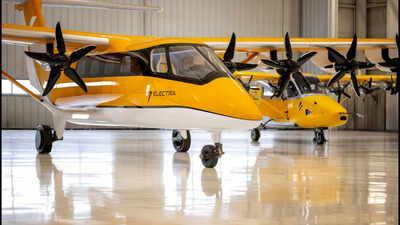
A class project at the Massachusetts Institute of Technology (MIT) in 2017 studied a new type of aircraft; now, it has ballooned into a $850 million Ohio factory plan for an 8-motor hybrid plane that can take off from an area the size of a soccer field. According to MIT Campus News report, a classroom experiment at MIT could soon change how people view air travel over short distances. As reported, a hybrid aircraft capable of operating without conventional runways is migrating from the university workshop to an intended $850 million manufacturing facility in Ohio, with the potential to enable quieter, faster and more accessible regional flights. The plane is from Electra, a company that grew out of an idea first explored by MIT graduate students in 2017. The end result is an eight-motor hybrid aircraft that can transport nine passengers, travel about 1,200 miles and cruise at around 200 miles per hour.
From the MIT classroom to the runway
The idea was born in the MIT course 16.886 Air Transportation Systems Architecting . SM ’19, PhD ’24 Chris Courtin was on a student team examining alternatives to the increasingly popular eVTOL concept. The students found that aircraft capable of short takeoffs and landings could be very useful for regional transportation. They wanted to combine light electric motors and batteries with a fixed-wing design, and it eventually became what Electra calls an ultra-short takeoff and landing aircraft. The idea lived on in MIT senior design projects, with students building and testing smaller versions in the Wright Brothers Wind Tunnel and in the air. Courtin later incorporated some of the work into his doctoral research. Aerospace entrepreneur John Langford joined the effort in 2019, and Electra was formally established along with founding technical advisers, MIT professors Mark Drela and John Hansman.
Eight engines make up a unique propulsion system
According to the news, Electra takes a different approach to hybrid aviation. Instead of a traditional engine operating the propellers, the aircraft has a gas-powered generator in the nose. During takeoff and landing, the generator and two batteries provide power to eight electric motors mounted across the wing. Once the aircraft is at cruising altitude, the generator provides most of the power and recharges the batteries. This arrangement allows the gas engine to be optimized for cruising, not the much higher power requirements of takeoff. The eight motors also produce what is known as a blown-lift effect. This system directs air over the wings to provide sufficient lift to allow the aircraft to operate from areas the length of a soccer field, and that could remove one of the biggest barriers to regional air travel: How to get to an airport in the first place.
Airports are not the only destination
Electra’s plane is being designed for trips of roughly 50 to 250 miles, a range that can be a tricky one for both airlines and ground transportation. Instead of several hours of driving to a major airport, passengers may be able to board the aircraft at smaller sites closer to home. The company plans to operate out of places such as parking lots, barges and soccer-field-sized spaces, as long as proper operating permissions and infrastructure are in place. The aircraft could also serve as a shuttle to major airports, allowing travelers to avoid congested roads without a traditional runway at their point of departure. Another potential benefit is noise. Electra says the aircraft can fly more quietly than traditional aircraft and helicopters with many smaller propellers instead of one or two big ones.
From prototype to an Ohio plant
The idea is already beyond the drawing board. The two-seat Electra EL2 demonstrator made its first test flights in 2023 and has accumulated more than 200 flights since. The company is now gearing up for its biggest move yet. Electra will spend $850 million to construct a 96-acre manufacturing center in Springfield and Clark County, Ohio. The project is expected to create about 1,975 jobs and construction is expected to start next year. The first stage of the factory should produce up to 400 nine-seater planes per year. A second phase could eventually raise production to about 800 planes a year.
Regional flight: A new beginning
Electra is also exploring military logistics, cargo transportation and humanitarian uses. But its passenger planes might be the most transformative if the company can make them affordable enough for broad use. This isn’t just about building another luxury plane. Electra aims to open regional air travel to many more people, with the simplicity of a fixed-wing plane with electric propulsion assist and ultra-short takeoff capabilities. So, what began as a classroom project at MIT in 2017 is becoming something much bigger: an effort to rethink the airport itself, and maybe make a soccer field as important to the future of regional aviation as a runway.