
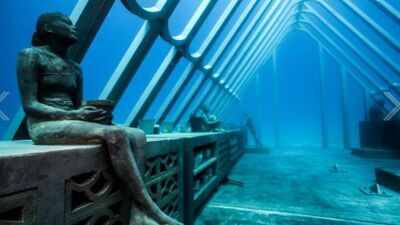
Beneath the surface of the Great Barrier Reef, a 165-tonne building is being slowly reshaped by the environment around it. The Coral Greenhouse, an underwater installation at John Brewer Reef, was designed to work with the sea rather than simply sit on the seabed. Coral can grow across its surfaces, fish can move through its open framework, and small marine animals can use its sheltered spaces. Even the architecture responds to the water, with elevated beams allowing currents to pass while creating surfaces for organisms to settle.Inside, sculptures of children sit among spaces designed for coral and marine life, creating an unusual meeting point between art and habitat. Over time, the distinction between the man-made structure and the surrounding reef is expected to become less obvious as living organisms gradually occupy the concrete and steel.
The Coral Greenhouse is designed to evolve with the reef
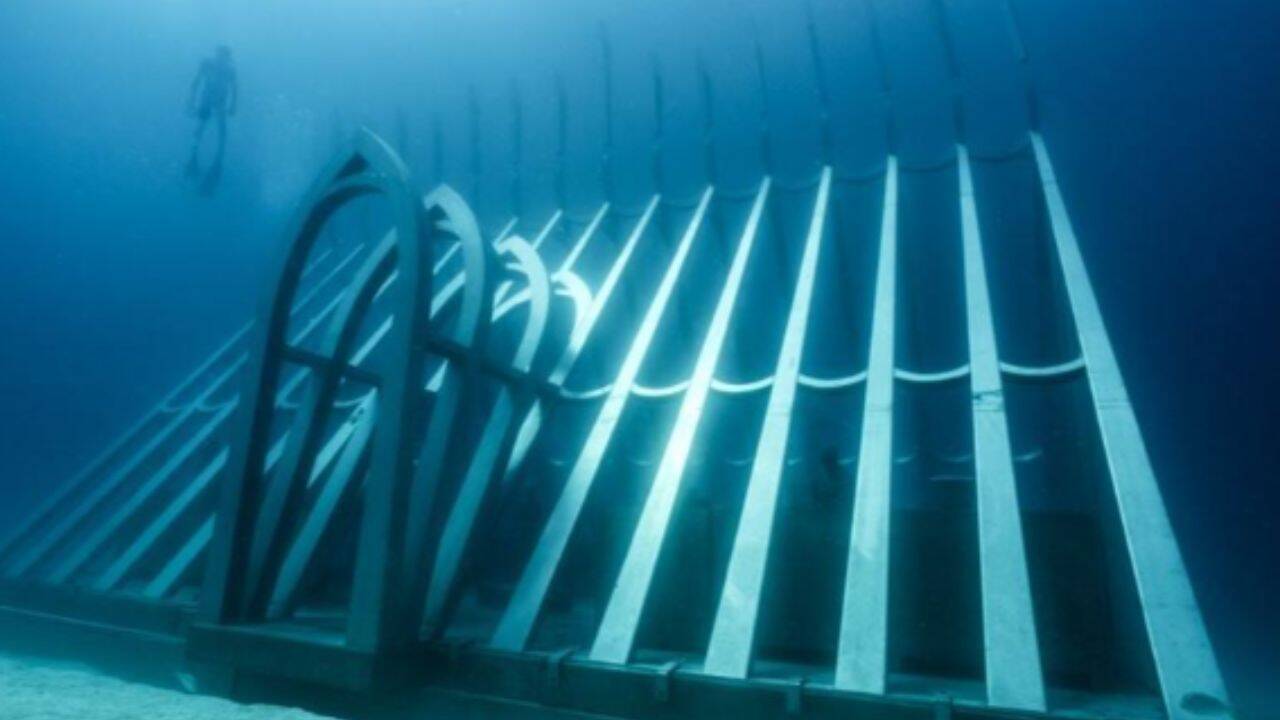
The Coral Greenhouse was conceived with the expectation that it would not remain visually unchanged. Its surfaces provide places where coral and other marine life can establish themselves, so the structure is intended to become increasingly integrated with the reef rather than stand apart from it.That idea is reflected in the building’s unusual form. The framework is open and porous, allowing light to reach the interior and giving divers plenty of room to move around. Three entrances, each about two metres across, open into the main space. Inside, the floor is sufficiently broad for divers to pause and look at the sculptures rather than simply passing through.The architecture has also been shaped around the conditions found underwater. Its triangular sections keep the centre of gravity low, while the broad concrete base gives the building weight and stability. Integrated cyclone tethers provide additional protection during severe weather.The upper beams have a different role. Their elevated position reduces the amount of resistance they present to waves while creating surfaces where filter-feeding organisms can settle. Fish can gather around them, too. In that sense, parts of the structure function almost like pieces of artificial reef, although the building remains recognisable as an architectural installation.
PC: Underwater Sculpture
How The Coral Greenhouse stays stable beneath the Great Barrier Reef
The main structure weighs about 165 tonnes, with the weight concentrated towards its base. Above that, lighter spires rise into the water and move with prevailing currents. The lower portion is deliberately substantial, while the upper elements have enough movement to respond to their surroundings. That movement is possible because of the marine setting and forms part of the way the installation interacts with the water around it.Materials were selected with the underwater environment in mind. The concrete used for the sculptures is pH neutral, while 316 stainless steel provides corrosion resistance for the metal components. Rather than simply placing an ordinary building underwater, the project required the structure to be engineered around saltwater, currents, storms and the organisms that would eventually occupy it.
Marine life finds shelter throughout The Coral Greenhouse
Inside, the work benches are not merely decorative surfaces. They were conceived as small reef habitats, with different spaces intended to suit different creatures.Some of the finer structures create hiding places for small fish, particularly animals seeking cover from predators. Other enclosed areas provide daytime shelter for creatures such as octopuses and sea urchins.That makes the interior an active part of the installation. A visitor may arrive expecting to see a collection of sculptures and instead encounter fish using the architecture for shelter or marine organisms growing across surfaces that were originally bare.The surrounding area extends the same idea beyond the central building. Gardens and paved sections lead towards larger planter-like structures containing coral, while floating trees rise above the seafloor. Their forms draw on plants found on land in the region, including eucalyptus and umbrella palms, but underwater they become something quite different.
The reef is slowly transforming The Coral Greenhouse
The most important part of the installation’s appearance may be something that was never fixed by the artist.As coral settles and grows across the structures, sections that were once sharply defined become covered or altered. Other organisms occupy the surfaces and spaces around them. The result is a gradual shift from an installation made by people towards something increasingly shaped by biological growth.That process means the museum cannot be considered finished in the usual sense. Its appearance depends partly on what happens in the surrounding reef and on which organisms establish themselves there.For divers, this also means that the experience can change with time. The sculptures remain in place, but their surfaces, colours and surroundings are not static.
A different way to experience the Great Barrier Reef
The Coral Greenhouse was created to offer a different point of access to the reef and the science surrounding it. Marine biology, coral gardening, environmental art and architecture meet within the same underwater setting.Its location at John Brewer Reef places the installation directly within the marine environment it is intended to help people understand. The building does not recreate a reef inside a museum. Instead, visitors enter an existing marine landscape and encounter an artificial structure that is gradually becoming part of it.There is no clear boundary between exhibit and habitat. A sculpture can provide shelter. A beam can become a surface for organisms. Coral can eventually obscure part of a figure. Water movement can alter the floating elements overhead.That constant interaction is central to what makes The Coral Greenhouse different from a museum on land. Its architecture was designed to accommodate change, and the reef itself is responsible for much of what the structure will eventually become.