
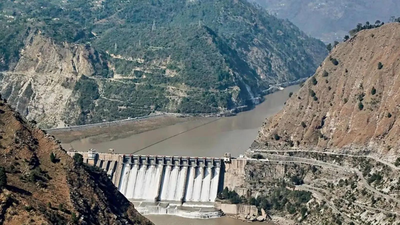
NEW DELHI: Union jal shakti minister CR Patil on Tuesday said that the Narendra Modi government is working to ensure that Pakistan receives no water from the Indus river system in the coming years. Patil said the treaty had not been terminated but suspended, and that efforts were underway to stop water flowing across the border. “It still stands; rather, the treaty has been kept in abeyance. And since Prime Minister Modi took this decision, every effort is being made to ensure not a single drop flows there,” he said.Patil added that the issue was being closely monitored at the highest levels of government. “Under the Prime Minister’s directives, Home Minister Amit Shah is also personally monitoring the matter, and we are actively working on it. I believe the work is proceeding in a time-bound manner. It is certain—not a single drop of water will go in the coming years; I can tell you that much.”His remarks came after heightened tensions between the two countries following the Pahalgam terror attack and India’s subsequent decision to place the 1960 treaty in abeyance.Earlier, the ministry of external affairs rejected the authority of the Court of Arbitration constituted under the treaty. Responding to a recent award issued by the tribunal on the “maximum pondage” issue, MEA spokesperson Randhir Jaiswal said India regarded the court as illegally constituted and would not recognise any of its decisions.“India categorically rejects the present so-called award, just as it has firmly rejected all prior pronouncements of the illegally constituted CoA,” Jaiswal said, adding that any proceedings, awards or decisions issued by the tribunal were “null and void”.India has long argued that the arbitration mechanism was set up in violation of the treaty and has challenged the court’s jurisdiction over disputes relating to the Kishenganga and Ratle hydropower projects in Jammu and Kashmir.Meanwhile, concerns over water availability have intensified in Pakistan. Karachi is currently facing a severe water shortage, with reports suggesting that nearly 70 per cent of the city is experiencing supply disruptions. Political leaders have blamed administrative failures for the crisis, even as Pakistan grapples with growing uncertainty over future water flows under the Indus system.