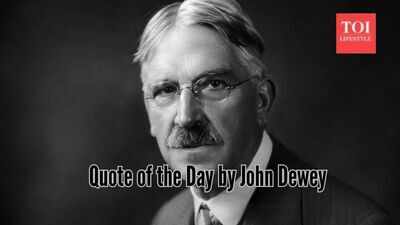
John Dewey has been the single most influential figure in modern education. In an era of memorisation, strict discipline, and one-way teaching, Dewey argued that education should be active, meaningful and closely connected to real life. His ideas changed classrooms across the globe, inspiring teachers to swap rote learning for curiosity, problem-solving and hands-on experiences.John Dewey was born in Burlington, Vermont, on October 20, 1859. He was raised in post-Civil War America, a country experiencing rapid industrialisation and social change. He graduated from the University of Vermont, and after teaching school for a time, studied philosophy at Johns Hopkins University, where he earned his doctorate. Dewey later taught at the Universities of Michigan, Chicago and Columbia, where he spent most of his career. His work was not limited to philosophy, but also extended to psychology, politics and education. He was one of the most influential intellectuals of the twentieth century.Unlike many philosophers Dewey did not remain locked in abstract theories . He believed ideas should solve real-world problems . This practical attitude was called pragmatism, a philosophical movement that judged ideas on their practical effectiveness rather than abstract principles.Transforming educationWhen Dewey began writing on education, schools were still largely authoritarian. Teachers lectured, students took notes, textbooks were learnt by heart and exams measured success. Dewey challenged all that. In 1896 he founded the renowned Laboratory School at the University of Chicago. Instead of concentrating on academic subjects, students learned mathematics through cooking, science through gardening and history through hands-on activities. Learning was relevant to everyday life and was no longer confined to textbooks. This philosophy would be called, later, “learning by doing”. Today, project-based learning, activity-based classrooms, experiential education, and inquiry-based teaching all have roots in Dewey’s ideas. His best known work, Democracy and Education (1916), remains one of the most influential books in the field of educational philosophy.Other contributions for educationDewey is best known for his work as an education reformer, but his impact extended far beyond education. He made a significant contribution to psychology by stressing that people learn through interaction with the environment and not through passive watching. In philosophy he redefined pragmatism. He said that knowledge is a dynamic, ever-evolving thing through experience.In politics he campaigned for democratic participation, social justice and equal educational opportunities for all citizens. Progressive education movements across Europe, Asia and Latin America were also influenced by his ideas. Even contemporary notions such as lifelong learning, collaborative education, reflective practice and design thinking are indebted to the work of Dewey.His legacyDewey’s philosophy underlies many educational practices that today seem perfectly normal. Despite the continued reliance on memorisation in the examination systems of many countries, educational reforms increasingly embrace creativity, collaboration and practical application – values espoused by Dewey more than 100 years ago. His influence has spread beyond schools to universities, workplaces and professional training programmes, where experiential learning has become a widely accepted method of skills development.Quote of the DayOne of the most iconic quotes of the author is, ” From the standpoint of the child, the great waste in the school comes from his inability to utilize the experiences he gets outside the school in any complete and free way within the school itself; while, on the other hand, he is unable to apply in daily life what he is learning at school. That is the isolation of the school — its isolation from life.” This statement, written over a century ago, captures one of the biggest challenges in education, even in the digital age.This quote sums up what Dewey took to be the main problem with traditional education: the failure to connect school and life. He opens by saying that kids can’t often bring their real life experiences into the classroom. Each child brings to school a rich world of experience – family traditions, neighbourhood friendships, hobbies, games, observations, questions, and daily discoveries. But many classrooms leave these experiences out altogether.A child who helps grandparents in the kitchen already knows measurements. A cricket lover knows the value of teamwork and strategy. Others who garden on weekends have first hand knowledge of plants and seasons. But traditional education often treats all students as if they are starting from scratch. This is a tremendous waste, Dewey says, because education becomes divorced from what children already know. The second part of the quote highlights another serious problem. Students often have trouble applying the classroom to real life. A child may learn to memorise mathematical formulas without knowing how to calculate the household expenses. They might learn the scientific definitions, but not the reasons food spoils. They may be taught about protecting the environment, but still have habits that damage nature. Children should use their experiences to make sense of classroom concepts, and classroom learning should help them to navigate everyday life more thoughtfully.John Dewey cautioned us that education should never be in isolation. Schools are not isolated worlds cut off from society; they are meant to prepare children to participate in it meaningfully. His quote ends with a call for education that connects classroom learning with real-life experience, so that knowledge becomes useful, relevant and transformative. More than a century later, as educators rethink learning for an AI-powered world, Dewey’s message seems more relevant than ever: the real purpose of education is not merely to help children pass tests, but to help them understand life – and live it well.