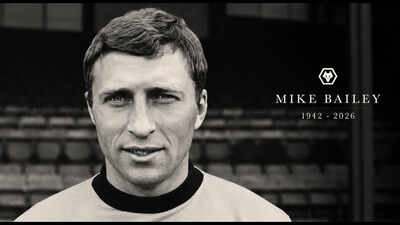
Wolverhampton Wanderers legend Mike Bailey has died aged 84 following a long battle with dementia, bringing an end to the career of a player who captained the club through one of the most important periods in its history.Bailey spent 11 years at Molineux between 1966 and 1977, making 436 appearances and scoring 25 goals. He also won two England caps, having represented his country in 1964.Bailey had been diagnosed with dementia in 2017. According to ExpressAndStar.com, his family revealed his battle with the degenerative condition in an interview with the outlet six years ago, saying they believed years of heading footballs throughout his life had contributed to it.His death was announced as former Wolves team-mates and supporters were already mourning the loss of another Molineux great, Phil Parkes, who died earlier this month.
Bailey’s Wolves career
Bailey joined Wolves in 1966 and during his first full season was part of the side that won promotion back to the top division in 1967. He was named Midlands Player of the Year that season and went on to become one of the defining figures of the team during the club’s revival in English football in the 1960s and 1970s.Wolves reached the Uefa Cup final in 1972 with Bailey as a key figure, although they were beaten 3-2 by Tottenham Hotspur in an all-English final.Two years later, Bailey finally lifted a major trophy with Wolves when he captained the side to a 2-1 League Cup final victory over Manchester City at the old Wembley Stadium. Wolves described it as his “finest afternoon at the club”.The club paid tribute to Bailey in its official statement, highlighting the qualities that made him such an important figure at Molineux.“During that popular Wolves stint, Bailey was known by those on the Molineux terraces for his love of a tackle, creative passing and eye for the occasional spectacular strike, but more than all that, his leadership,” the club said.
‘One of Wolves’ greatest ever captains’
John Richards, the former Wolves goalscorer and chairman of the Wolves Former Players’ Association, paid tribute to Bailey as “one of Wolves’ greatest ever captains”.“Coming so soon after the passing of Lofty (Phil Parkes), who was one of Mike’s close pals within our team, this is another devastating loss,” Richards said.“I can’t fully describe how much respect I have for Mike as a player and as a person.“His influence on us as players, both with his leadership and his performances, is something that made him such a massive part of the dressing room.“He was a great captain, not only in how he led the team but also the individual pieces of advice and guidance he gave to each of us as players.”Richards also recalled what it meant to see Bailey lift the League Cup at Wembley after such a long career without a major trophy.“When we won the League Cup final in 1974, with Mike as captain, we were all just as pleased for him as we were for ourselves because, up until then, he had gone through such an incredible career without lifting a trophy,” Richards said.“To see him go up there at Wembley and lift the trophy is one of my greatest ever Wolves memories.”Richards said Bailey remained connected to the club long after his playing career ended, regularly returning to Wolverhampton for matches and events and later serving as chairman of the former players’ association.“In recent years, he responded to illness with the same courage and determination as he displayed during his football career, and we send all our best wishes and condolences to Barbara, Victoria, Andy and the family,” Richards said.“Wolves has lost one of its greatest ever captains, but his achievements and influence will never be forgotten.”
From Molineux captain to management
Bailey left Wolves in 1977 after 11 years at the club and continued playing in the United States with Minnesota Kicks before returning to England for one final season with Hereford. He retired from playing in 1979 and subsequently moved into management.His managerial career included spells with Hereford, Charlton, Brighton, Greek club OFI and Leatherhead, extending his involvement in football well beyond his playing days.For Wolves, however, Bailey’s legacy remained rooted in the period when he led the club on the pitch, from promotion back to the top division through European competition and ultimately to the League Cup triumph at Wembley.