
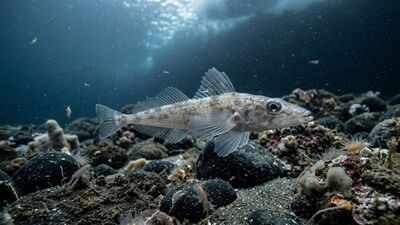
A fish is living beneath the Antarctic ice with no red blood cells, no haemoglobin, and in some species, no myoglobin either. Its blood is pale, watery, and almost clear. Normally, an animal without these oxygen-carrying proteins should not survive. Yet the Antarctic icefish, from the Channichthyidae family, has lived in the freezing Southern Ocean for millions of years. It is the only known vertebrate that loses haemoglobin as an adult. Scientists have spent decades studying how it survives, and what they have discovered has changed the way they think about oxygen transport, the heart and how animals adapt to extreme environments.
What makes the Antarctic icefish different from every other vertebrate
A 2006 commentary paper, “When bad things happen to good fish: the loss of haemoglobin and myoglobin expression in Antarctic icefishes,” published in the Journal of Experimental Biology by Bruce D. Sidell of the University of Maine and Kristin M. O’Brien explains that the icefish did not lose haemoglobin because it was helpful. It disappeared because of a genetic mutation, and that came with serious disadvantages.Haemoglobin is the protein inside red blood cells that carries oxygen around the body. Without it, an icefish’s blood can carry less than 10% of the oxygen carried by the blood of closely related red-blooded fish. That is a huge difference.To survive, the icefish’s body changed in several ways. Its heart is four to five times larger, compared with its body size, than the hearts of related red-blooded fish. It also has up to four times more blood, and its blood vessels are much wider. These changes help move a larger amount of thin, oxygen-poor blood around the body more quickly.However, this comes at a cost. Icefish use about twice as much energy to pump blood as their red-blooded relatives. Some icefish also lost another important protein called myoglobin, which stores oxygen inside muscles. Scientists found that some species lost the protein through different genetic mutations at different times.This surprised researchers because studies showed that hearts containing myoglobin work better under stress. Losing myoglobin made the heart less efficient, not more.
How Antarctica’s freezing seas made survival possible
So if losing haemoglobin and myoglobin made life harder, why did the icefish survive?The answer lies in the Southern Ocean around Antarctica. Cold water can hold much more dissolved oxygen than warm water. In some places, where temperatures fall to around -1.9°C near the Ross Ice Shelf, the water is almost completely filled with oxygen.Because there is so much oxygen in the water, icefish can absorb some of it directly through their blood plasma and even through their scaleless skin. They do not rely entirely on haemoglobin to move oxygen around their bodies.Icefish also evolved from slow-moving fish with naturally low energy needs. They do not need as much oxygen as fast-swimming fish, which makes it easier for them to survive with much lower oxygen-carrying capacity.
The hidden chemical that may explain the icefish’s survival
Scientists believe another important piece of the puzzle may be a small signalling molecule called nitric oxide, often shortened to NO. When icefish lost these proteins, they also lost one of the main ways of breaking down nitric oxide. The researchers suggest this caused nitric oxide levels to rise throughout the body.The researchers suggest that losing haemoglobin and myoglobin triggered higher nitric oxide levels, which then caused many of the physical changes seen in the icefish today. Instead of solving the problem directly, the fish’s body gradually changed in ways that helped it survive despite losing two important oxygen-carrying proteins.