
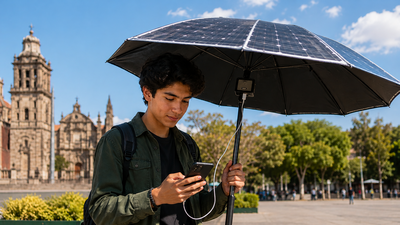
A commuter steps off a bus in midday heat, phone already at 12 percent, and no wall socket in sight. The scene is familiar in dense cities where charging infrastructure hasn’t kept up with device dependence. In that gap between mobility and power demand sits an idea that feels almost obvious once you see it: a solar-powered umbrella for charging that turns everyday shade into a small, personal energy source. It is not trying to replace the grid or even a power bank in full. It is trying to reclaim wasted surface area that already travels with the user.According to Solar Vision (S.V), the concept proposed by student designer Victoria García Moreno from Universidad Casa Blanca as part of the James Dyson Award submissions, pushes that logic further by embedding flexible photovoltaic cells into a waterproof canopy, routing harvested energy into a battery integrated into the handle. The result is a hybrid object: part weather protection, part emergency charger, part portable solar experiment.
Science behind solar umbrellas and their real-world energy limits
At its core, the solar-powered umbrella for charging is an exercise in surface utilisation. A typical compact umbrella opens to roughly 0.5 to 1.0 square meters of fabric area, depending on its radius. That is not trivial when you compare it to portable solar panels like the Anker 625 Solar Panel, which sits at around 0.6 square meters of active surface area in its fold-out form.The design logic is straightforward. If solar irradiance at peak sunlight is about 1,000 watts per square meter, then even modest conversion efficiency can produce usable power. Commercial flexible solar cells typically operate in the range of roughly 10 to 20 percent efficiency depending on materials and conditions. That means, in ideal sun exposure, an umbrella-sized surface could theoretically generate tens of watts.But theory and daily use diverge quickly. An umbrella rarely faces the sun at a perfect perpendicular angle. It moves, tilts, gets shaded by buildings, and is often used precisely when the user is trying to avoid direct sunlight. That tension sits at the center of whether the concept is genuinely useful or just visually clever.
How solar umbrellas actually work: From thin-film cells to USB-C charging in the handle
In García Moreno’s concept, the canopy is lined with waterproof flexible solar cells rather than rigid panels. These are typically based on thin-film technologies such as amorphous silicon or newer polymer-based photovoltaics. Their advantage is mechanical flexibility. Their trade-off is lower efficiency compared to rigid monocrystalline panels found in rooftop systems.Energy is routed down conductive threads embedded in the umbrella ribs into a battery housed in the handle. From there, USB and USB-C ports provide output for phones or small devices. In practical terms, that aligns with modern mobile charging standards. Most smartphones today carry battery capacities between roughly 10 to 15 Wh, meaning even a small solar trickle over time could meaningfully extend usage in emergency conditions.The James Dyson Award has previously highlighted similar attempts to merge sustainability with everyday objects, from water filtration backpacks to kinetic energy devices, though very few solar umbrella designs have moved beyond prototype stage.
Key engineering barriers limiting real-world solar umbrella adoption
Two challenges dominate serious development efforts. The first is the durability of the photovoltaic layer. Embedding solar cells into fabric sounds simple until you account for repeated radial stress along umbrella ribs. Every opening and closing cycle introduces micro-strain. Over hundreds of cycles, that strain compounds. Without robust encapsulation such as EVA (ethylene-vinyl acetate) layers used in solar panel lamination, degradation becomes a matter of months, not years.The second is energy management. Small-scale solar devices suffer from inconsistent input. Passing clouds can swing voltage output rapidly, which requires a charge controller capable of stabilizing power before it reaches a lithium battery. Without that regulation, battery life drops sharply. These are not unsolved problems, but they add cost and complexity that push the device away from being a simple consumer accessory.