
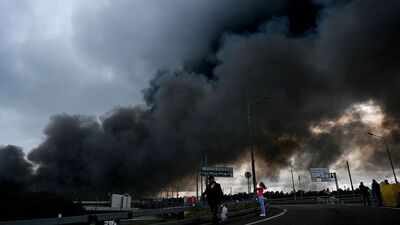
Nearly a week after Ukrainian President Volodymyr Zelenskyy approved a 40-day campaign aimed at increasing pressure on Russia through sustained long-range strikes, Kyiv’s expanding missile and drone offensive appears to be reshaping the geography of the war.According to a Bloomberg analysis of statements issued by Russian regional authorities, missile alerts have now been declared across areas accounting for more than 70 percent of Russia’s population, with warnings extending far beyond the border with Ukraine.Missile threat alerts were declared over the past week in at least five regions of Russia’s Volga Federal District, along with the southern Astrakhan region and at least four regions in the North Caucasus. Similar warnings were also issued in the Moscow, Vladimir, Tambov, Orel and Lipetsk regions.For the first time since the start of Russia’s full-scale invasion of Ukraine in 2022, a missile alert sounded in the Omsk region of western Siberia, about 3,000 kilometres east of the Ukrainian border.Ukraine’s expanding geographical reachThe latest spread of missile alerts shows how Ukraine’s deep-strike campaign has evolved since the war began in February 2022. During the initial months of the conflict, Russian authorities primarily issued missile and air raid warnings in regions bordering Ukraine, including Belgorod, Kursk and Bryansk, as well as in Russian-occupied territories such as Crimea.However, Ukraine has expanded the range and frequency of its strikes, targeting military airbases, logistics hubs, ammunition depots, defence-industrial facilities and energy infrastructure hundreds of kilometres beyond the frontline. Now, Ukraine’s targeting of facilities beyond the Ural Mountains highlights the widening geographical footprint of its long-range strike capability.Ukraine’s expanding strike radius is also having a growing impact on civilian life far from the frontline. In Samara, a city of around 1.2 million people on the Volga River, authorities temporarily suspended surface public transport during a missile alert this week, while the metro continued operating as a public shelter.In Russia’s Voronezh region, which borders Ukraine, a missile strike last week killed five people, prompting local authorities to issue air raid alerts almost daily thereafter. Meanwhile, Ukraine said it employed its newly developed Flamingo cruise missiles during a weekend strike in the Volgograd region, where local authorities reported two fatalities.
Ukraine missiles and drones
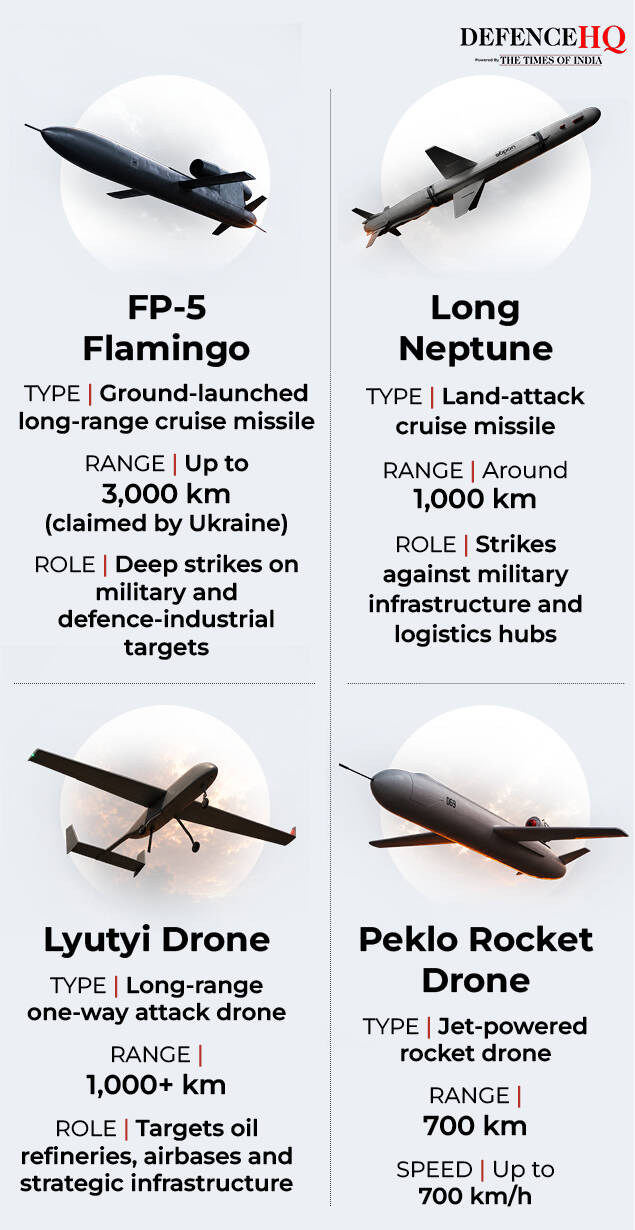
Ukraine’s long-range strike arsenalUkraine’s ability to strike deep inside Russian territory has increasingly relied on a combination of domestically developed cruise missiles and long-range attack drones. Since 2024, Kyiv has accelerated indigenous weapons development to reduce dependence on Western-supplied long-range missiles, allowing it to target military infrastructure, defence-industrial facilities and energy assets deep inside Russia.The FP-5 Flamingo is Ukraine’s newest indigenous ground-launched long-range cruise missile and has become a key element of its deep-strike campaign. Zelenskyy said in May that the missile successfully struck a defence electronics plant in Cheboksary, more than 1,500 km from Ukraine, while Ukraine claims the missile has a maximum range of up to 3,000 km.The Long Neptune is an extended-range land-attack version of Ukraine’s Neptune anti-ship missile, which gained international attention after sinking the Russian Black Sea Fleet flagship Moskva in April 2022. Zelenskyy claimed the missile’s range to be around 1,000 km. Ukraine has employed the missile against military facilities and infrastructure inside Russia, giving Kyiv an indigenous long-range cruise missile capability independent of Western restrictions.The Lyutyi one-way attack drone has become one of Ukraine’s principal long-range strike platforms. Produced by Antonov, it has an operational range of more than 1,000 km and has been repeatedly used against Russian oil infrastructure.Another drone in Ukraine’s arsenal is the Peklo rocket drone, which combines characteristics of a cruise missile and a jet-powered one-way attack drone. Peklo has a reported range of 700 km and a maximum speed of around 700 km/h.Fuel shortages across RussiaUkraine’s sustained campaign against Russia’s oil infrastructure is beginning to impose visible economic costs beyond the battlefield. In recent weeks, repeated drone and missile strikes on refineries, fuel depots and petroleum logistics hubs have disrupted refining operations and fuel distribution across the country.By the end of June, almost every Russian region had reported either fuel rationing or disruptions to gasoline supplies following Ukrainian attacks that temporarily halted operations at several key oil refineries.The fuel crisis initially concentrated in Russian-occupied Crimea and neighbouring southern regions, but the disruptions have since spread beyond these areas. Motorists in nearly every Russian region now face restrictions on the amount of fuel they can purchase, with the most stringent rationing imposed in Russian-occupied areas of Ukraine and large parts of southern Russia.Kremlin has publicly acknowledged the growing challenge. Russian President Vladimir Putin admitted that Ukrainian drone strikes had contributed to fuel shortages in several regions, while insisting that the government was taking steps to stabilise supplies.Ukraine’s expanding long-range strike campaign marks a significant shift in the character of the war, extending the battlefield far beyond the frontlines into Russia’s industrial and logistical heartland.The strikes have transformed Russia’s interior regions from safe havens into increasingly contested spaces, adding a new dimension to a war that is now in its fifth year.