
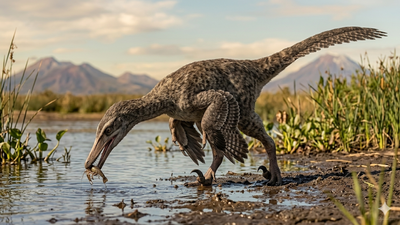
For decades, dinosaurs like Velociraptor have dominated our imagination as fast-moving predators that chased prey across dusty landscapes. But deep in the fossil-rich rocks of southern Patagonia, scientists have uncovered a very different kind of raptor, one that may have spent much of its life standing quietly beside rivers, waiting for fish.The newly identified dinosaur, Kank australis, lived around 70 million years ago, just a few million years before the asteroid impact that ended the age of dinosaurs. Its fossilised teeth, vertebrae and toe bones were discovered near El Calafate in Argentina’s Santa Cruz Province, revealing a species unlike any previously found in the region. Rather than behaving like the agile land hunters popularised by films, this predator appears to have had more in common with modern herons, using its specialised neck and sharp teeth to catch prey in wetlands and shallow waterways. The discovery is offering scientists a rare glimpse into a forgotten ecosystem that once flourished at the southern edge of the dinosaur world.
A predator hidden beneath Patagonia’s ancient rocks
The story of Kank australis did not begin with a complete skeleton emerging from the ground. Instead, it unfolded slowly over several years. The information derives from research titled ‘New unenlagiid from the Chorrillo Formation (Late Cretaceous, Maastrichtian), SW Patagonia, Argentina’ published in the Journal of Vertebrate Paleontology.Researchers first recovered fragmentary remains from the Chorrillo Formation in southern Patagonia. The fossils hinted that they belonged to a small predatory dinosaur, but there was not enough evidence to identify it as a new species. Then, during a later expedition, scientists uncovered a distinctive neck vertebra that changed everything. Combined with previously discovered teeth and toe bones, the fossil provided enough anatomical detail to confirm that they were looking at a dinosaur unknown to science.The name Kank comes from the mythology of the Aonikenk, or Tehuelche, people of Patagonia. It refers to an ancient giant rhea-like figure associated with the Southern Cross constellation. The species name, australis, means “from the south”, a tribute to the dinosaur’s southern Patagonian home.
The raptor that may have fished like a heron
What makes Kani Australis particularly fascinating is not simply that it is a new dinosaur, but how it may have lived. Scientists from the Argentine Museum of Natural Sciences studying its neck vertebrae found features associated with powerful and flexible neck movements. These adaptations closely resemble those seen in modern wading birds such as herons, which rely on precise, rapid strikes to catch fish. The dinosaur’s elongated jaws and numerous conical teeth further support the idea that it specialised in catching slippery aquatic prey.Dr Matías Motta, lead author of the study published in the Journal of Vertebrate Paleontology, noted that Kank lived in a landscape filled with rivers, streams and seasonal ponds. Fossil evidence suggests the region supported fish, insects, molluscs and aquatic plants, creating an environment very different from the colder and drier Patagonia seen today.Rather than sprinting across open ground in pursuit of prey, Kank may have spent hours patiently waiting near the water’s edge before striking with surprising speed.
Why this discovery matters to dinosaur science
At first glance, Kank australis might seem like just another addition to the dinosaur family tree. In reality, its discovery helps solve a much larger puzzle.The species belongs to a group known as unenlagiids, southern hemisphere relatives of famous raptors such as Velociraptor. Fossils from this family have previously been found in South America, Antarctica, Madagascar and Australia. However, scientists lacked clear evidence connecting populations from southern Patagonia to those found elsewhere. Kank helps bridge that geographical gap, strengthening the idea that these predators were widely distributed across ancient southern continents.Researchers estimate that the animal grew to around 2.5 to 3 metres in length, making it considerably smaller than some of Patagonia’s giant predators. Yet its discovery highlights an important truth about the age of dinosaurs: ecosystems were far more diverse than popular culture often suggests. Not every predator was a giant hunter chasing massive prey. Some, like Kank australis, may have carved out their own niche beside rivers and wetlands, living lives that looked surprisingly familiar to the birds we see today.
A reminder that Patagonia still holds secrets
More than 70 million years after it disappeared, Kani Australis has emerged from the rocks to tell a new chapter in dinosaur history.The discovery demonstrates that even in some of the world’s most studied fossil regions, entirely new species are still waiting to be found. Every fossil unearthed in Patagonia adds another piece to the story of life before the mass extinction that changed Earth forever.And if Kank has taught palaeontologists anything, it is that the next remarkable dinosaur may already be hidden beneath the ground, waiting for someone to recognise its significance.