
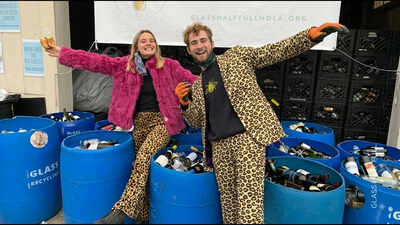
What began as a conversation over a bottle of wine between two Tulane University students has grown into an unusual experiment in recycling and coastal restoration. Franziska Trautmann and Max Steitz, the founders of Glass Half Full, have transformed millions of discarded glass bottles into sand, material that is now being tested to help rebuild Louisiana’s disappearing wetlands.Speaking to The New York Times, Steitz recalled the moment the pair began thinking about what would happen to their empty wine bottle. “We kind of pondered the destiny of that glass bottle,” he said, knowing it would probably end up in a landfill. The thought eventually led to a simple question: “Why not us?”
How two Tulane students started crushing bottles into usable sand
The idea began in 2020, when Trautmann and Steitz realised that New Orleans had a major gap in its recycling system. While visiting Germany, Trautmann had seen how widely glass was recycled there, but back home in Louisiana, discarded bottles often had nowhere to go except landfill.The pair began collecting bottles from friends and fellow students and crushing them on a small scale. As word spread, the amount of glass grew rapidly.Eventually, their project became Glass Half Full, a recycling operation with a much larger processing facility. Instead of allowing bottles to become waste, the company sorts and crushes them into different grades of recycled glass, including material fine enough to be used as sand. By 2024, the operation had diverted more than 3 million pounds of glass from landfills.
Why turning bottles into sand matters beyond recycling
The founders discovered that crushed glass could have a much bigger purpose than simply keeping bottles out of landfill.Glass is largely made from silica, the same basic material found in sand. That means discarded bottles can effectively be transformed back into a sand-like material rather than requiring new natural sand to be mined.The idea is particularly relevant in Louisiana, where coastal wetlands are disappearing at an alarming rate.Trautmann explained that the project’s main goal had always been to address Louisiana’s coastal erosion crisis, where the state was losing land at an extraordinary pace.The recycled glass therefore connects two environmental problems: a growing waste stream and a coastline desperately in need of sediment.
Twenty tons of recycled glass are helping restore Louisiana marshes
Glass Half Full eventually began working with researchers and conservation groups to test whether recycled glass sand could be safely incorporated into coastal restoration.One of the most striking applications involved placing 20 tons of glass sand into wetland restoration projects. The material was used with burlap bags and vegetation to help slow erosion, trap sediment and create conditions where marsh plants could establish themselves.The approach is not simply about replacing natural sand with crushed bottles. Scientists have been studying whether the recycled material behaves safely in wetland environments and whether it can support vegetation without releasing harmful substances.Early results have been encouraging, with marsh grasses growing around restoration structures and helping reinforce the newly developing habitat.
Louisiana’s disappearing wetlands give the experiment an urgent purpose
Louisiana’s coastline is particularly vulnerable because wetlands can disappear through a combination of erosion, land subsidence, storms and rising sea levels.Those wetlands perform important ecological and protective functions. They provide habitat for wildlife and can help absorb some of the energy of storms before it reaches communities farther inland.Restoring them requires enormous quantities of sediment. Glass Half Full offers a different source of material: bottles that people have already used and discarded.Rather than extracting additional material from natural environments, the project gives an existing waste stream another purpose.
The founders are turning a local recycling problem into a coastal experiment
The scale of the operation is a dramatic change from the project’s beginnings. What started with two students collecting bottles eventually grew into a dedicated recycling facility processing large quantities of glass. The founders have also explored other uses for the crushed material, including landscaping and disaster-relief sandbags.But the coastal work gives the project its most ambitious purpose. The idea is deceptively simple: collect a material that would otherwise be discarded, crush it into a usable form and place it where Louisiana’s landscape needs additional sediment.Whether recycled glass can become a major tool for coastal restoration remains a question for researchers. But the experiment demonstrates how an ordinary household waste product can be connected to a much larger environmental challengeAnd it all began with two students looking at an empty wine bottle and wondering what would happen to it next.