
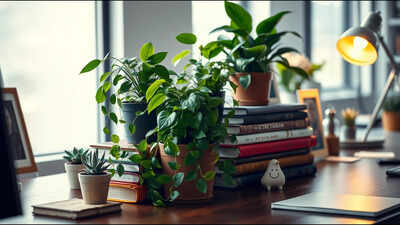
I strolled through two floors of my office to find the most interesting office desk. Yes, it can be a pastime gimmick for me. But agree or not, your desk says a lot about your office personality, much like your home walls whisper about your hobbies and little obsessions. No wonder we get a bit possessive about our desk and belongings, because decorating it our way makes it “ours.”Some desks are properly decked up with plants, while others are wrapped up with books. An adorable family picture or maybe a cute little panda. Your work desk tells aloud what you keep hiding in your heart.Some desks are neatly decked out with leafy plants; others disappear beneath piles of books and notebooks. There are family photographs, tiny souvenirs, quirky figurines, motivational quotes, and, occasionally, a cute little panda staring back at you from beside the monitor. Then there are desks so meticulously organised that every pen appears to be properly kept and others so cluttered that finding a stapler feels like an archaeological expedition.Of course, a desk cannot diagnose your personality. Science does not say that a plant makes you empathetic or a pile of books automatically makes you curious. But psychologists have found that people do use physical spaces and personal objects as cues when forming impressions of others.And that makes the humble office desk rather intriguing.Because sometimes, the things we casually leave around us can reveal the things we don’t consciously announce, what we value, what catches our attention, how we like to work, and perhaps even the professional image we project.Your work desk may not tell your whole story.But it might be whispering parts of it aloud.
What does research say?
Research suggests that people use physical environments as sources of information when forming impressions about their occupants. In a landmark 2002 study published in the Journal of Personality and Social Psychology, psychologists Samuel D. Gosling, Sei Jin Ko, Thomas Mannarelli and Margaret E. Morris examined whether observers could make personality judgments from offices and bedrooms alone. They found that independent observers formed similar impressions of occupants, and, for some traits, those impressions showed meaningful accuracy. The researchers also found evidence that observers used identifiable environmental cues when making their judgments.Your desk may be speaking before you do.
Books may hint at curiosity, but don’t tell the whole story
Imagine walking past two desks. At the first sits a laptop, a water bottle, and little else.Imagine you are walking past two desks. At the first sits a laptop, a water bottle and a few other things. The second one makes you pause to check the books it is piled up with. History, classics, and economics book, accompanied by a notebook filled with handwritten notes, is enough to give you an impression that the second person is more curious and intellectually engaged.There is some research behind that instinct, although it needs to be handled carefully.That does not mean every person with three books on their desk is secretly an intellectual powerhouse. But it does suggest something intriguing: the objects people choose to display can communicate aspects of how they want to be perceived.And that can matter at work.
A plant does not mean you’re the office’s most peaceful person
The little green plant kept at your table might not emanate a perception that you are an emotionally balanced person. But it can definitely change the ambiance of your workspace and perhaps the way you experience work.Reams of research have uncovered that personality is related to personalisation, although the relationship is influenced by factors such as an employee’s status and the type of workspace they occupy.The plant may not scream “empathetic person,” but it may simply tell that this person has made this space their own.And that distinction matters.
The immaculate desk can send a different message
Then there is the employee whose desk appears to have been arranged with a ruler. Notebook perfectly aligned. Pens in one holder. Documents filed. Nothing unnecessary.A visitor may associate that order with conscientiousness, discipline and reliability.Research has indeed found that people make personality judgments from environmental cues such as organisation and clutter.But there is a catch.A clean desk does not automatically mean a highly conscientious employee. And a messy desk does not automatically belong to an incompetent one.That distinction is important because perception is not the same as personality.Your manager is seeing a snapshot, not your psychological profile.
And then there is the fascinating case of the messy desk
Here is where the story gets more interesting.A chaotic desk may sometimes communicate disorganisation. But mess is not always the enemy of creativity.Psychological research has explored the relationship between physical order and behaviour, with findings suggesting that disorder can sometimes encourage less conventional thinking, while orderly environments can encourage more conventional choices.So the person surrounded by papers, sketches, and half-finished ideas may not necessarily be careless.They might simply be working differently. The real question, therefore, is not whether a desk is messy or clean.It is whether the workspace appears functional.A desk covered in active projects, notes and books can look like a laboratory of ideas. A desk buried under old coffee cups, forgotten paperwork, and unopened files tells a different story.
Can you desk decide your promotion?
This is where workspace psychology gets particularly relevant to promotions.Promotions are not determined by desk aesthetics. Performance, skills, leadership, reliability, communication, and organisational needs remain far more important.But careers are also built on visibility and perception.If your desk communicates that you are prepared, organised, curious, creative or invested in your work, it can reinforce the professional identity you are trying to establish.Think of it as a supporting actor. It cannot win the film for you. But it can influence the scene.A manager who repeatedly sees an employee surrounded by project notes, reference material, and organised files may unconsciously associate that person with preparation and involvement. Someone whose workspace reflects personal interests, creative work, or thoughtful organisation may appear more distinctive and engaged.These impressions can become especially relevant when several employees have broadly similar qualifications and performance records.
So what should your desk actually look like?
Perhaps the smartest approach is surprisingly simple. Make your desk look like you work there.Keep the things that help you work. Display a few objects that reflect your interests. Keep essential documents accessible. Remove distractions and unnecessary clutter. If a plant makes the space more pleasant, keep one. If books help you learn, let them sit there.The goal isn’t to manufacture an image.It is to create a workspace that reinforces the qualities you want your professional life to reflect.Because your desk is not your résumé.But it may be part of the story people tell themselves about you before they ever open it.And sometimes, in the strange theater of office life, the smallest props can influence the biggest impressions.