Most years, skywatchers have to wait patiently for different celestial events to arrive one at a time. An eclipse might dominate one month, while a meteor shower steals attention weeks later. This August, however, the calendar has produced a rare overlap. On 12 August 2026, a solar eclipse will unfold across parts of the Northern Hemisphere, and later that same night the annual Perseid meteor shower will reach its peak.The pairing is unusual enough on its own. Yet there is another twist. The same lunar alignment that makes the eclipse possible will also create some of the darkest skies of the month, giving the Perseids particularly favourable conditions after sunset. According to the BBC, the eclipse and meteor shower will effectively form a day-and-night astronomical double bill, with observers able to watch two of the year’s most anticipated sky events within a matter of hours.
Solar Eclipse to align with the Perseid meteor shower on August 12, 2026: Nasa confirms
Nasa’s Meteoroid Environment Office regularly monitors meteoroids and their behaviour, not only for scientific study but also because even relatively small fragments can pose risks to spacecraft. Bill Cooke, who leads the office, said meteoroids remain one of the most significant hazards facing spacecraft and crews travelling beyond Earth orbit. According to Cooke, Nasa studies meteor activity through observations, impact monitoring and detector development to better understand and reduce those risks. For people watching from the ground, though, those same particles can produce one of the most attractive natural displays of the year.By the time darkness settles on 12 August, the eclipse will be over, the Moon will be largely out of sight, and the Perseids will be climbing towards their peak. It is not often that a solar eclipse and one of the year’s best meteor showers share the same date. This summer, they do. And for anyone willing to spend both day and night looking upward, the sky will provide two very different spectacles within a single rotation of Earth.Although the eclipse and meteor shower seem unrelated, but they share a surprisingly important link. Solar eclipses occur only at new Moon, when the Moon occupies roughly the same region of the sky as the Sun. During this phase, the side of the Moon facing Earth is dark and largely absent from the night sky. That matters because moonlight is one of the biggest obstacles to meteor watching. A bright Moon can wash out faint meteors, leaving only the most luminous streaks visible.According to the BBC, the new Moon accompanying the August eclipse means lunar glare will be almost absent during the Perseid peak. The Moon will also set near the same time as the Sun, leaving the night sky unusually dark for meteor observers.
Total solar eclipse 2026: Which countries will see total and partial phases
The daytime event begins when the Moon passes between Earth and theSun, blocking sunlight and casting its shadow across part of the planet.On 12 August, a total solar eclipse will trace a narrow corridor across Greenland, Iceland and parts of Spain. Those positioned within this path will experience the Moon completely covering the Sun for a brief period. Elsewhere, a much larger region will witness a partial eclipse, with the lunar disc appearing to carve away a substantial portion of the Sun’s face.According to the BBC, large areas of Europe, parts of North America and regions of North Africa will see at least a partial eclipse. In the United Kingdom and Ireland, many locations are expected to witness more than 90 per cent of the Sun obscured, creating an unusually deep partial eclipse for millions of people.For observers in western Europe, timing may add an extra layer of visual interest. The eclipse occurs late in the day, meaning the Sun will be descending towards the horizon while still partially covered by the Moon.
Perseid meteor shower 2026: Best viewing tips for August 12–13
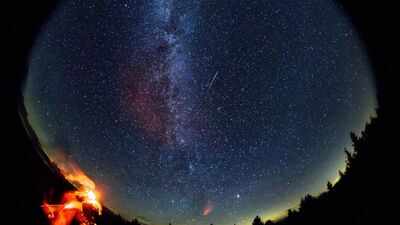
Once the eclipse fades and evening settles in, attention shifts to a completely different phenomenon. The Perseid meteor shower occurs each year when Earth passes through material left behind by Comet Swift-Tuttle. Tiny fragments enter Earth’s atmosphere at tremendous speeds and burn up high above the surface, producing the familiar flashes known as shooting stars.The shower is active for several weeks, but its strongest activity is expected around the night of 12–13 August. According to the BBC, the Perseids are widely regarded as one of the year’s most reliable meteor displays because they often produce large numbers of meteors, including exceptionally bright fireballs that can leave lingering glowing trails across the sky.Unlike the eclipse, viewing the Perseids requires no specialised equipment. In fact, binoculars and telescopes can make meteor watching more difficult by restricting the field of view. The best approach is often the simplest: lie back, look upward and allow as much of the sky as possible to remain visible.
How to protect your eyes during the upcoming solar eclipse 2026
Unlike many astronomical events, a solar eclipse demands preparation before stepping outside. Looking directly at the Sun without proper protection can cause serious eye damage, even when much of the solar disc appears hidden. Reported by the BBC, that certified eclipse glasses should be used during all partial phases of the event. The publication notes that even if only a tiny portion of the Sun remains visible, the eclipse is still considered partial and protective eyewear remains essential.People unable to obtain eclipse glasses can use indirect viewing methods instead. Projecting sunlight through objects such as a colander or similar perforated surface can create multiple miniature eclipse images on the ground without requiring anyone to look directly at the Sun.As per Nasa, the importance of observing solar activity safely. The agency notes that meteor and asteroid awareness events held each summer encourage public interest in the sky, but observing the Sun always requires appropriate precautions and equipment. According to Nasa, simply spending time outdoors under dark or clear skies remains one of the easiest ways to engage with astronomy, provided safety guidelines are followed.