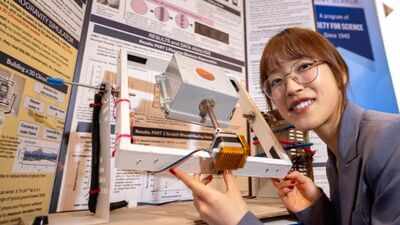
Leanne Fan, an 18-year-old student from San Diego, has been named a finalist in the 2026 Regeneron Science Talent Search for her research into wound healing in space. Her project looks at whether red light therapy can help wounds heal when gravity is greatly reduced.According to the organisers of the talent hunt, Fan, a student at Westview High School, studied how wounds respond to photobiomodulation, a technique that uses red or near-infrared light to trigger biological effects. Her research focused on a problem that could become important during future space missions, where astronauts may have limited access to medical care.Wounds can heal more slowly in space because tissues do not experience the same mechanical loading caused by gravity. To study this, Fan built a device that could simulate microgravity on Earth. The device continuously rotates along two axes, preventing gravity from acting on the wound sample in only one direction.Fan developed her own version of the device rather than using a NASA clinostat, which costs about $50,000. Her device cost around $200. She then used planarians, or flatworms, as a model for studying wound healing because they can regenerate body parts.
Red light speeds up healing
Fan treated injured flatworms in simulated microgravity with 660-nanometre red light. The treatment increased tissue regeneration by 95.2%.Fan also found that five minutes of daily photobiomodulation accelerated healing by 47% under normal gravity and by 95% under simulated microgravity. She also tested the treatment on wound models made with human cells.Those tests showed that red light treatment increased cell migration during wound closure by 29.4% under normal gravity conditions. The human cell tests were important because they allowed Fan to examine whether her findings could potentially apply beyond the flatworm model.“I tested photobiomodulation, a technique that uses red or near-infrared light to trigger biological effects,” Fan explained. “Since I couldn’t test in actual space, I needed to simulate microgravity.”Her findings could have applications beyond space travel. The Society for Science said the work could help develop new ways to treat injuries in remote areas, during natural disasters and in other situations where access to medical care is limited.Fan said the technology could also make wound care easier to provide in places where weight, cost and power use are important concerns.“This technology would enable us to build wound healing interventions that cost under a dollar, weigh less than a gram, and require minimal power; even beyond space, photobiomodulation can address critical global health needs,” she said.
A low-cost alternative
Fan’s project was selected from more than 2,600 entries for the 2026 Regeneron Science Talent Search, according to the Poway Unified School District. The district said this was the largest applicant pool for the competition since 1967.The finalist recognition came after months of experiments. Fan said she spent long hours working on the project after completing her schoolwork, including measuring and studying the flatworms used in her research.“It’s incredibly exciting and my mind was blown when I got the announcement phone call,” she said. “I spent months… measuring and decapitating worms late into the night after finishing hours of schoolwork, so being a finalist makes it feel like my effort paid off.”Fan plans to continue the research to better understand how photobiomodulation works at a biological level. She said the project has also changed how she approaches difficult research problems.“It’s such an amazing feeling to be able to build and research something with your own two hands that has the potential to help countless people,” she said as quoted by Poway unified school ditrict. “Research has come with so many difficulties, but the more I overcome them, the more comfortable I feel with exploration and pushing the bounds of my comfort, in research but also in life,” she adds.
From AI headphones to wound healing
The wound-healing project is not Fan’s first research effort involving light and technology. Earlier, she worked on a project that used headphones to detect bacterial ear infections with artificial intelligence and treat them with blue light.Outside her research, Fan is the editor-in-chief of her school newspaper. She helped bring the publication back after the Covid-19 pandemic, when the paper had lost staff, its printer went out of business and the publication shifted online.She was also a US youth delegate at COP29, the 2024 United Nations climate conference in Azerbaijan, and served as the elected student board member for her school district.Connor Hill, 17, of State College, Pennsylvania, won the top award of $250,000 in the 2026 Regeneron Science Talent Search (STS). This year marks the 85th anniversary of the Science Talent Search.