
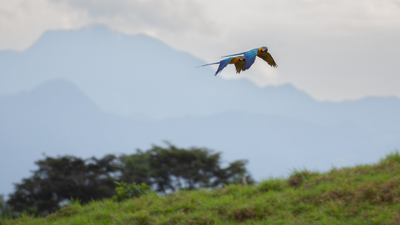
Thousands of hours of rainforest recordings are helping scientists teach artificial intelligence to recognise Amazonian birds that can be difficult to identify by sound alone. In Colombia, Cornell researchers have been collecting acoustic data from cattle ranches, rubber agroforestry plots and forest to build a clearer picture of which species are using each landscape. The recordings were analysed using BirdNET Analyser, an AI-powered bioacoustics tool that was trained with help from local Colombian birders. The work has enabled the system to identify 11 additional bird species and recognise calls from 76 other Amazonian forest birds. Beyond improving automated bird identification, the project is being used to examine whether rubber agroforestry can provide habitat for species that depend on forest. Early observations suggest some forest birds use, and in certain cases favour, rubber-growing areas, raising the possibility that biodiversity data could eventually support conservation certification and provide farmers with an alternative to cattle ranching.
Cornell researchers use BirdNET AI to improve Amazonian bird identification
The project grew out of fieldwork carried out in Colombia during 2023 and 2024 by Cornell doctoral candidate Charlie Tebbutt and undergraduate research assistant Dhruv Varun Cohen. Across four rounds of fieldwork, the team gathered extensive acoustic recordings from several landscapes. Rather than relying entirely on visual sightings, they could capture the sounds produced by birds moving through vegetation, calling from concealed locations or remaining out of sight altogether.That created a different sort of problem. A rainforest recording can contain calls from many species at once, along with insects, other animals, wind and the constant background noise of the forest. Identifying everything manually would take an enormous amount of time. The team therefore worked with Colombian birders Wilmer Ramírez Riaño and Diana Lucena Gavilán to train BirdNET Analyser, an AI-powered bioacoustics system developed through Cornell’s K. Lisa Yang Centre for Conservation Bioacoustics. The training helped the software learn calls it had previously struggled to recognise. According to Cornell Chronicle University, BirdNET can now correctly identify 11 additional species from this work, while its ability to recognise another 76 Amazonian forest birds has been demonstrated.
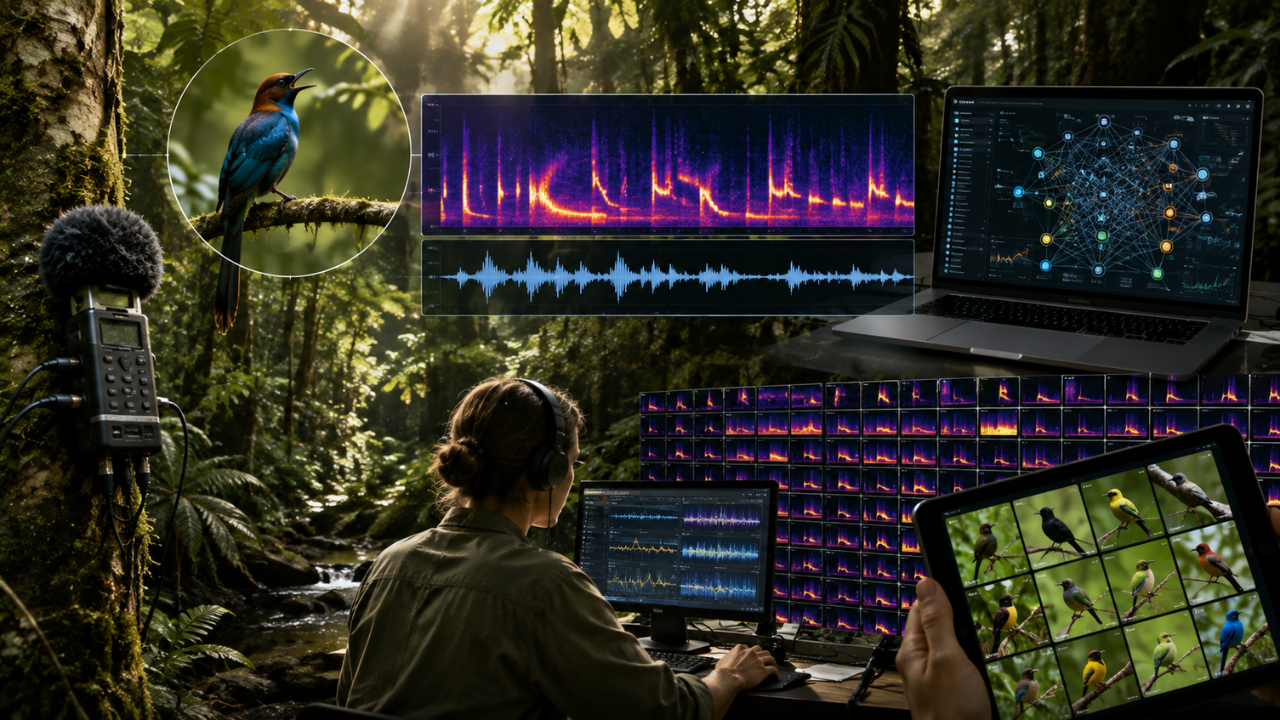
PC: Image AI generated
How AI learns to recognise Amazonian bird calls from complex rainforest sounds
Teaching an automated system to recognise a bird is not simply a matter of feeding it recordings and waiting for an answer. The quality and range of the reference material matter, particularly in a place as acoustically complicated as the Amazon. Birds may call from different distances, produce overlapping sounds or sound slightly different depending on the circumstances. Local knowledge was therefore an important part of the process, helping the researchers establish what was actually present in the recordings.Once the system had been trained, the recordings became useful for a much larger comparison. Tebbutt is examining bird communities across three broad settings: cattle ranches, rubber agroforestry plots and forest. The aim is to see which species use each landscape and whether growing rubber alongside other vegetation can retain some of the ecological conditions that birds need. The approach allows large amounts of recorded material to be processed without requiring researchers to identify every call by ear.
Rubber agroforestry supports more Amazonian bird species than cattle pasture
The early results suggest that rubber agroforestry can offer considerably more to birds than open cattle pasture. Forest-dependent species such as the Black-faced Antbird were detected in agroforestry areas, while Amazonian Trogons and Buff-throated Woodcreepers appeared to favour these plots in some cases. The picture was different in cattle pasture, where the native birds able to use the open landscape tended to be highly mobile species such as toucans and macaws.Even those adaptable birds cannot necessarily live entirely in pasture. Tebbutt told Cornell that some still require forest for a particular stage of their lives or for functions such as nesting. That distinction matters because simply counting birds in a landscape does not tell the whole story. A species may cross an open area or feed there while still depending on nearby forest to reproduce or survive.The researchers are interested in whether these differences can eventually be translated into a practical system for valuing biodiversity on rubber farms. If bird communities can provide a measurable indication of ecological conditions, the information could potentially contribute to biodiversity certification for sustainably produced rubber. Such certification could give farmers another source of income while making conservation benefits more visible to buyers.
Consumer pressure and regulations influence sustainable material sourcing decisions
The research is tied to a wider question about why companies choose more sustainable materials in the first place. Alongside the fieldwork, Tebbutt interviewed business leaders involved in sourcing products including rubber, cacao, cotton and pharmaceuticals. The conversations were intended to understand what actually pushes companies towards environmental standards, rather than assuming that concern for nature is always the main factor.The strongest influence identified in those interviews was government regulation, followed by consumer pressure and the risks companies face in securing materials. Tebbutt described a mixture of approaches among the businesses he spoke to. Some were mainly responding to regulatory requirements, while others focused on the longer-term importance of healthy landscapes and ecological systems to their operations.That business perspective is relevant to the Colombian Amazon because cattle ranching remains an important livelihood option, even where forest creates serious ecological costs. Tebbutt’s research is based on the idea that conservation becomes more practical when farmers have an economically workable alternative. Rubber agroforestry could potentially form part of that alternative if its environmental benefits can be documented and recognised in the market.For the scientists, the rainforest recordings are therefore doing more than helping an AI system become better at identifying bird calls. They are building a detailed picture of how wildlife responds when forest is replaced, retained or incorporated into agricultural land. As Tebbutt put it in the Cornell account of the project, “we hypothesise that if we can make it more financially sustainable for growers to do rubber agroforestry,” more of the Amazon’s bird community may be retained.The next stage will involve turning the findings into scientific and policy-focused material for businesses, governments and conservation organisations. The recordings collected in the forest provide the raw evidence; the trained AI makes it possible to analyse that evidence at a much larger scale. What emerges from those comparisons could help establish whether rubber agroforestry is not simply a commercial crop system, but also a landscape in which a meaningful part of Amazonian bird diversity can persist.