
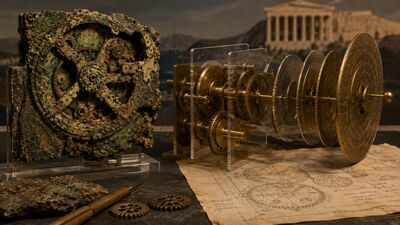
The Moon does not travel across the sky at a constant pace. Its speed changes throughout each orbit, a detail ancient astronomers noticed long before they had the mathematics to explain it fully. More than two thousand years ago, the makers of the Antikythera Mechanism found a way to reproduce this unevenness using bronze gears alone. According to the study published in Nature, titled ‘Decoding the ancient Greek astronomical calculator known as the Antikythera Mechanism’, the device was a geared instrument built towards the end of the second century BC that calculated and displayed celestial information, including lunar phases and a combined lunar-solar calendar. Buried among its fragments was a solution to a problem that would not be addressed mathematically in surviving records for centuries. This article looks at how the mechanism handled the Moon’s changing speed and why the solution still surprises researchers today.
Why the Moon’s speed changes during its orbit around Earth
The Moon’s motion looks simple from Earth, but it is not uniform. Because the Moon follows an elliptical rather than circular orbit, it moves faster when nearer to Earth and slower when farther away. Ancient observers tracking the Moon against the stars would have noticed it gaining and losing pace over the course of a month, a pattern that repeats but does not follow a straight, predictable rhythm.The Greek astronomer Hipparchos, working in the second century BC, developed a theory to explain these irregularities in the Moon’s motion, attributing them to its elliptical orbit. This placed the problem within reach of Greek astronomy of the period, but explaining an effect in theory and building something that could physically replicate it are different challenges. The team behind the 2006 study set out to establish whether the Antikythera Mechanism had actually managed the second part.According to NASA, the Moon spins on its axis at a slow, steady rate, completing one rotation per orbit, but it moves along its elliptical path at a speed that changes depending on its distance from Earth, pulling ahead of a steady, circular pace near one point in the orbit and lagging behind it near the other, points known as perigee and apogee. This modern description matches what Hipparchos had already worked out roughly two thousand years earlier, and it is the same variation the Antikythera Mechanism’s makers set out to reproduce. The team behind the 2006 study set out to establish whether the mechanism had actually managed this.
How the Antikythera Mechanism used gears to recreate the Moon’s changing speed
Solving the problem mechanically meant finding a way to make a gear turn at a speed that itself kept changing, rather than at the fixed rate gears normally produce. The approach that survives in the mechanism’s fragments used two gears mounted slightly off-centre from one another, connected by a pin fixed to one gear that rode inside a slot cut into the other. As the gears rotated, the pin was forced to slide back and forth within the slot, and this sliding motion sped up and slowed down the output in a repeating pattern rather than a constant one.High-resolution X-ray tomography and surface imaging of the surviving fragments allowed the research team to reconstruct this gearing and confirm what it was designed to do. The findings indicated that the mechanism contained a mechanical realisation of Hipparchos’s theory of the Moon, built directly into its gear train. The researchers described this as revealing an unexpected degree of technical sophistication for the period, since it meant translating an abstract astronomical explanation into a working physical device using nothing more than bronze wheels, a pin and a slot.
How the Antikythera Mechanism predicted lunar eclipses using ancient astronomy
What the pin-and-slot arrangement generated, in effect, was a smoothly repeating rise and fall in speed, the mechanical equivalent of a wave pattern. This is significant because trigonometric sine tables, the standard mathematical tool for describing such wave-like variation, would not appear in the surviving historical record until many centuries later. The mechanism reached a working, physical version of this kind of variation through gearing rather than through calculation on paper.The reconstruction work doubled the number of inscriptions the researchers were able to decipher, and these confirmed that the mechanism predicted lunar and solar eclipses using Babylonian arithmetic-progression cycles alongside the geometric lunar theory built into its gears. This combination of two different astronomical traditions, Babylonian arithmetic and Greek geometry, within a single instrument points to how much technical knowledge had already converged by the time the mechanism was built.
Why the Antikythera Mechanism is considered the world’s oldest analogue computer
The broader significance of this particular piece of gearing is that it demonstrates a level of mechanical thinking not seen again for well over a thousand years. The Antikythera Mechanism is technically more complex than any known device built for at least a millennium after it, a gap that makes the pin-and-slot solution to the Moon’s variable speed especially notable.Modern accounts of the mechanism often describe it as the world’s oldest known analogue computer, and the lunar speed mechanism is a clear example of why that description holds up. It was not simply a display of information gathered elsewhere, but a device that carried out a calculation through its physical construction, arriving at an answer through moving parts rather than written figures. That a solution of this kind existed so early, and was then lost for so long, remains one of the more striking aspects of the mechanism’s rediscovery.