
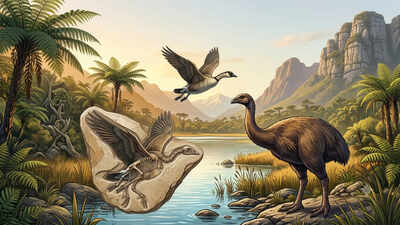
Nature never fails to surprise us and sometimes it throws some unimaginable findings that are beyond human calculation. In a recent study, a rare fossil goose was discovered in the remains of an ancient lake in Central Otago, and it is now changing scientists’ understanding of how New Zealand’s unique bird life evolved. The study was carried out by an international team from the University of Otago, the Museum of New Zealand Te Papa Tongarewa, and the University of Cambridge (UK), which examined fossil material recovered from the well-known St Bathans fossil deposits.
A new species hidden in fossils
The research, published in Historical Biology, states that although waterfowl fossils are abundant at St Bathans, goose remains are much less common. When the team re-examined every fossil bone previously identified as belonging to geese, they compared those remains with other fossil waterfowl from the site as well as an extensive collection of modern and extinct bird skeletons. And it was determined that those bones included an undescribed species, the size of a small goose.
What’s the name of new specie
The newly identified bird has been named Meterchen luti. Its name is inspired by the nursery rhyme Old Mother Goose, reflecting the idea of an ancient goose emerging from the mud of a fossil deposit. Meterchen means “mother goose” in ancient Greek, while luti is Latin for “of the mud.”The study notes that The St Bathans goose is not closely related to the recently-extinct giant flightless New Zealand geese (Cnemiornis species) or their Australian cousin, the Cape Barren goose.
New Zealand’s bird evolution
According to experts, combined with this recent genetic evidence, the discovery suggests New Zealand’s bird history is much more complex than scientists once assumed. It is believed that many bird species reached New Zealand over millions of years, but the ancestors of some of the country’s best known large birds arrived surprisingly recently. It is being said that those more recent arrivals date back only 4-5 million years, including takahē, Forbes’ harrier, and the giant Haast’s eagle.
What does the early theory states
According to an early theory, the St Bathans goose represented the direct ancestors of giant flightless Cnemiornis geese, implying this lineage had a very long history (of at least 14 million years) in Zealandia. However, this conflicts with genetic evidence suggesting that the ancestors of Cnemiornis arrived from Australia only about seven million years ago, which proponents of the earlier theory discarded.
The dynamic past of fossil
The lead professor of the study believes that the ancestors of the St Bathans goose reached Zealandia more than 14 million years ago, but their lineage eventually disappeared without leaving surviving descendants. In his opinion, with the help of all the tools, we can reconstruct how the dynamic geological, climatic and human history of Zealandia has shaped the evolution of Aotearoa fauna in ever more detail.Another striking example of rapid morphological change that can occur in a short time frame on islands is the relatively recent evolution of the giant flightless Cnemiornis geese. These were the largest geese in the world, standing one metre tall and weighing up to 18kg.