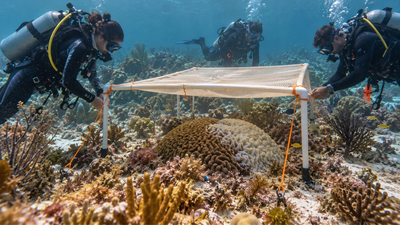
Coral reefs are facing increasingly intense heat stress, and scientists in Florida have tested an unusual way to give vulnerable corals temporary relief: underwater “umbrellas”. During a 2024 experiment in the Florida Keys, researchers placed custom-built shade structures over colonies of two brain coral species as ocean temperatures climbed to exceptionally high levels. The structures reduced the amount of light reaching the corals by about 60%, limiting the additional light and ultraviolet stress that can intensify heat-related bleaching. Shaded corals lost less colour during the period of greatest thermal stress, and some regained colour after the shades were installed. The experiment, led by researchers at Nova Southeastern University, provides evidence that temporary shading could help individual corals cope with short periods of extreme heat.
Why corals lose their colour
Coral bleaching occurs when environmental stress disrupts the relationship between corals and microscopic algae living inside their tissues. These algae, known as symbionts, provide much of the energy corals need and contribute to their characteristic colours. When water becomes unusually warm, corals can expel or lose these algae, leaving their tissues pale or white. A bleached coral is not necessarily dead, but prolonged heat stress can leave it weakened and more vulnerable to disease, starvation and mortality. Repeated bleaching has become a major concern in the Florida Keys, where severe regional bleaching events have occurred in 1997–98, 2005, 2014–15 and 2023. A 2026 study found that reef-building capacity in the region declined from about 1.65 millimetres of growth per year in 1996 to net erosion of about 0.12 millimetres per year after the 2023 bleaching event.
How the underwater umbrellas were built
The experiment was led by marine biologist Karen L. Neely of Nova Southeastern University, along with Caroline Dennison, Kathryn Toth, Arelys Chaparro and Andrew Baker. At Newfound Harbor in the Florida Keys, the researchers installed 20 temporary shade structures over 10 coral colonies belonging to Pseudodiploria clivosa and Colpophyllia natans. Another 20 colonies served as unshaded controls. The structures were made from pipes and nylon cloth, secured to the seabed and positioned about 30 centimetres above the coral colonies. Their purpose was not to cool the surrounding seawater but to reduce the amount of intense sunlight reaching the coral. Measurements showed that the shades cut incoming light by approximately 60%, reducing the combination of heat and intense irradiance that can worsen coral bleaching.
What happened during the heat
The trial took place during the summer of 2024, when Newfound Harbor experienced its second-highest cumulative heat stress on record. Researchers visited the experimental colonies approximately every two weeks to record changes in coral colour and collect tissue samples. The shaded colonies generally lost less colour during the periods of greatest thermal stress, and some showed signs of colour recovery after the shade structures were installed. The findings were especially notable because the shades were deployed after water temperatures had already reached levels capable of causing bleaching. This means the structures were being used after heat stress was already underway rather than as a preventive measure before temperatures rose. The researchers found no evidence that the temporary structures caused harmful effects elsewhere in the surrounding ecosystem during the experiment.
Heat-tolerant algae played a role
The corals in the experiment also had a potentially important advantage. Most of the colonies were associated with Durusdinium, a group of symbiotic algae known for its greater tolerance of high temperatures. The researchers suggest that the dominance of these heat-tolerant algae may have been influenced by the severe bleaching experienced in the Florida Keys during 2023. Corals can change their dominant algal partners following major heat events, and associations with more heat-tolerant algae can improve their ability to withstand thermal stress. However, these partnerships can involve trade-offs, including lower coral growth. The study found no clear difference in algal density or species composition between the shaded and unshaded colonies, although the researchers noted that their tissue samples had to be collected from coral edges, where light conditions differ from the centre of a colony.
Earlier shading could make a difference
One of the notable findings from the experiment was related to timing. The shades were installed only after the corals had already experienced enough heat stress to reach bleaching thresholds. Researchers therefore believe that deploying the structures earlier in a heat event could potentially provide greater protection. Coral bleaching develops as environmental stress accumulates, so reducing excessive light exposure before the corals become severely stressed could change how they respond to prolonged heat. The 2024 experiment showed that even relatively late intervention was associated with reduced paling and some colour recovery, giving researchers a basis for testing whether earlier deployment produces stronger results. Future experiments can examine how quickly shades need to be installed once temperatures begin rising and how long they need to remain in place.
Where the method could be used
The researchers see temporary shading as a potential tool for protecting particularly valuable corals rather than as a method for covering entire reef systems. Coral nurseries, restoration sites and small areas containing rare or especially important colonies could potentially be prioritised during short periods of extreme heat. The structures are temporary, meaning they can be deployed when thermal stress peaks and removed when conditions improve. Such targeted protection could be useful for restoration programmes that have invested years in growing or transplanting coral colonies. It could also give vulnerable colonies additional time to survive a heat event while broader restoration and conservation measures continue.
Scaling up remains difficult
The experiment involved only 20 shade structures covering 10 coral colonies, making large-scale deployment a very different engineering challenge. A reef can contain thousands or millions of individual organisms spread across a large area, while structures placed underwater must withstand waves, currents, storms and changing sea conditions. Large-scale shading would also require decisions about which corals receive protection when resources are limited. The researchers therefore describe the experiment as a proof of concept showing that reducing light exposure can influence coral responses to heat stress. Turning that finding into a practical reef-management tool would require larger experiments, improved structures and evidence from different coral species and environments.
Scientists now want to study longer-term effects
The immediate response of coral colour is only one part of the question. Researchers also need to determine whether temporary shading affects what happens to corals months after a heat event. Future work will examine potential effects on disease, reproduction and longer-term coral health, as well as whether corals maintain benefits after the shades are removed. The study published in Frontiers in Marine Science provides evidence that reducing intense light can lessen coral paling during extreme heat, but it also highlights the complexity of protecting reefs as marine temperatures rise. For Florida’s vulnerable corals, the experiment offers a simple idea with a striking appearance: when heat becomes too intense, giving corals some shade may help them hold on to their colour and withstand the worst of the stress.