Horses have a hidden poker face when they face danger, hiding severe internal stress from their handlers even as their hearts beat at extremely high speeds.A study from The Ohio State University found that horses can instantly recognise a predator just by seeing it, even when it appears on a silent video screen with no smells, sounds, or past experiences to help them. Despite feeling stressed inside, the horses showed almost no visible signs of fear, staying physically calm and leaving riders unaware of what they were experiencing.“Rather than just spooking, horses show remarkable cognitive restraint when evaluating a potential threat,” said lead author Zeynep Benderlioglu, a senior lecturer in evolution, ecology and organismal biology at The Ohio State University. “And not all fear or stress will result in overt behavior. They’re not in fight-or-flight mode, but they’re assessing, and they’re doing it in a remarkably fast way. But their hearts are racing at the same time.“The findings, published on July 15, 2026, in the journal PLOS One, show an important gap between what horses feel internally and what people can see, something that could affect both animal welfare and rider safety.
Measuring hidden equine panic
The study was carried out at the Ohio State Equine Center, run by the Department of Animal Sciences. Researchers tested 18 horses of different ages, breeds, and sexes. Each horse stood inside a regular stall while wearing an equine heart monitor, and a video camera recorded its movements.To make sure the horses reacted only to what they saw, Benderlioglu removed all other sensory cues. The horses watched a silent video divided into three 20-second clips. The first clip, used as the control, showed peaceful wombats grazing in a field. The other two clips showed groups of wolves either fighting with each other or grooming themselves.The researchers divided the horses into two groups to change the viewing order. Half watched the fighting wolves first, while the other half saw the grooming wolves first.
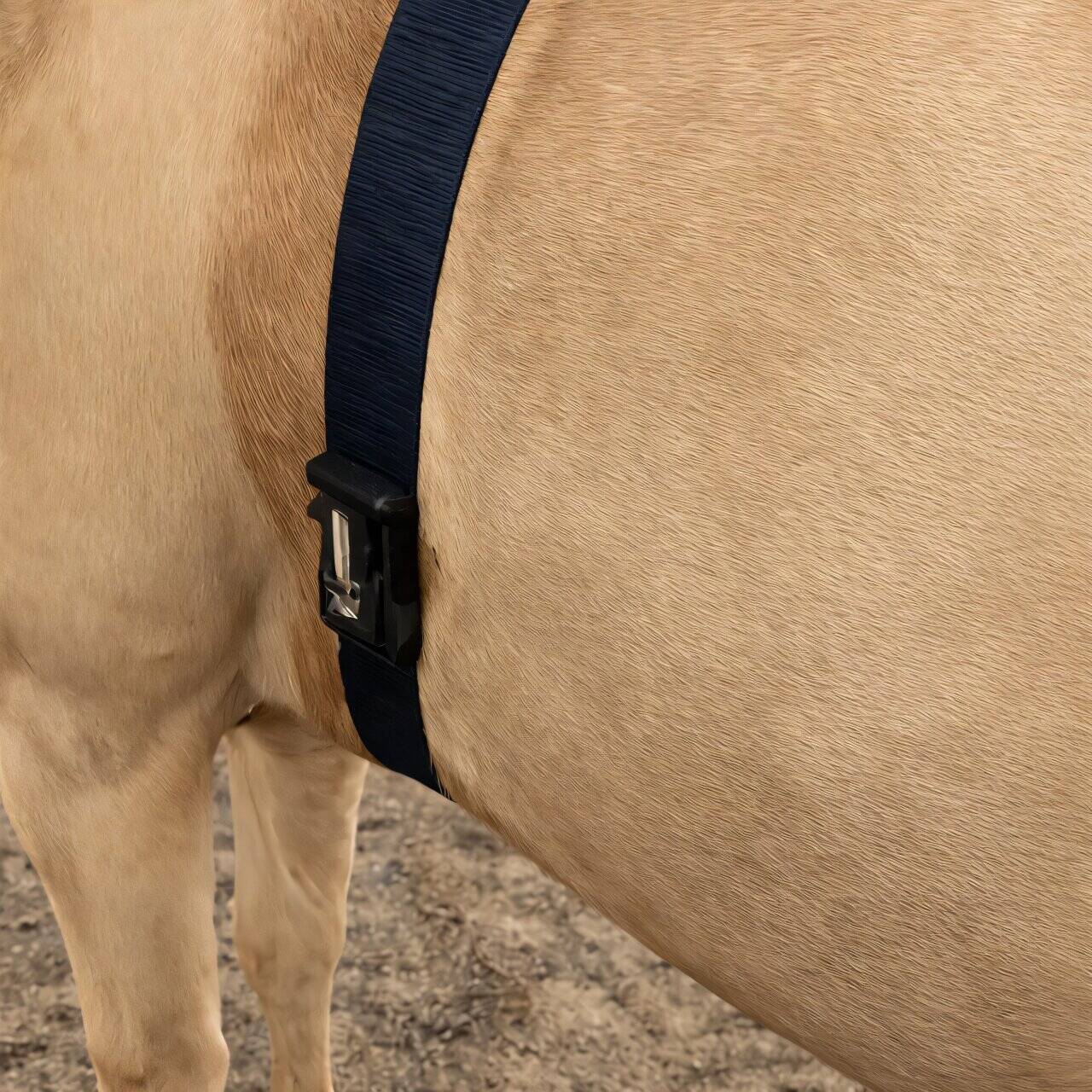
A view of the heart-rate monitor applied to each horse during the experiment. Credit: Zeynep Benderlioglu
A surprising lack of physical panic
While watching the wombats, the horses kept a normal resting heart rate. However, their heart rates rose sharply as soon as wolves appeared on the screen.Surprisingly, the wolves’ behaviour made no difference. The horses showed the same strong increase in heart rate whether the wolves were fighting or simply cleaning their fur.“I expected the horses would differentiate the fighting videos from the grooming videos, but they didn’t. They had high alertness and a higher heart rate compared to baseline and wombats when looking at both grooming and fighting wolves,” said Benderlioglu, who also directs the Undergraduate Research Lab in Ohio State’s Department of Evolution, Ecology and Organismal Biology.Even though their hearts were beating much faster, the horses did not show the usual signs of stress. They did not swish their tails, throw their heads, or pin their ears back. To a normal observer or handler, the horses looked completely calm.
The burden of herd leadership
The study found that stress levels differed depending on the horse’s sex and social position. Researchers collected background information from the horses’ regular handlers, including their age, sex, temperament, fearfulness, and rank within the herd.Male horses showed a much stronger internal response to the predator videos than female horses. Although both sexes had similar resting heart rates, the males experienced much higher heart-rate increases when the wolves appeared.In the same way, horses with a dominant position in the herd showed much larger heart-rate spikes during the predator scenes. Benderlioglu believes this is linked to the responsibilities of leadership. Dominant horses are often followed by others because the herd trusts them to make important decisions, especially when it comes to staying safe.
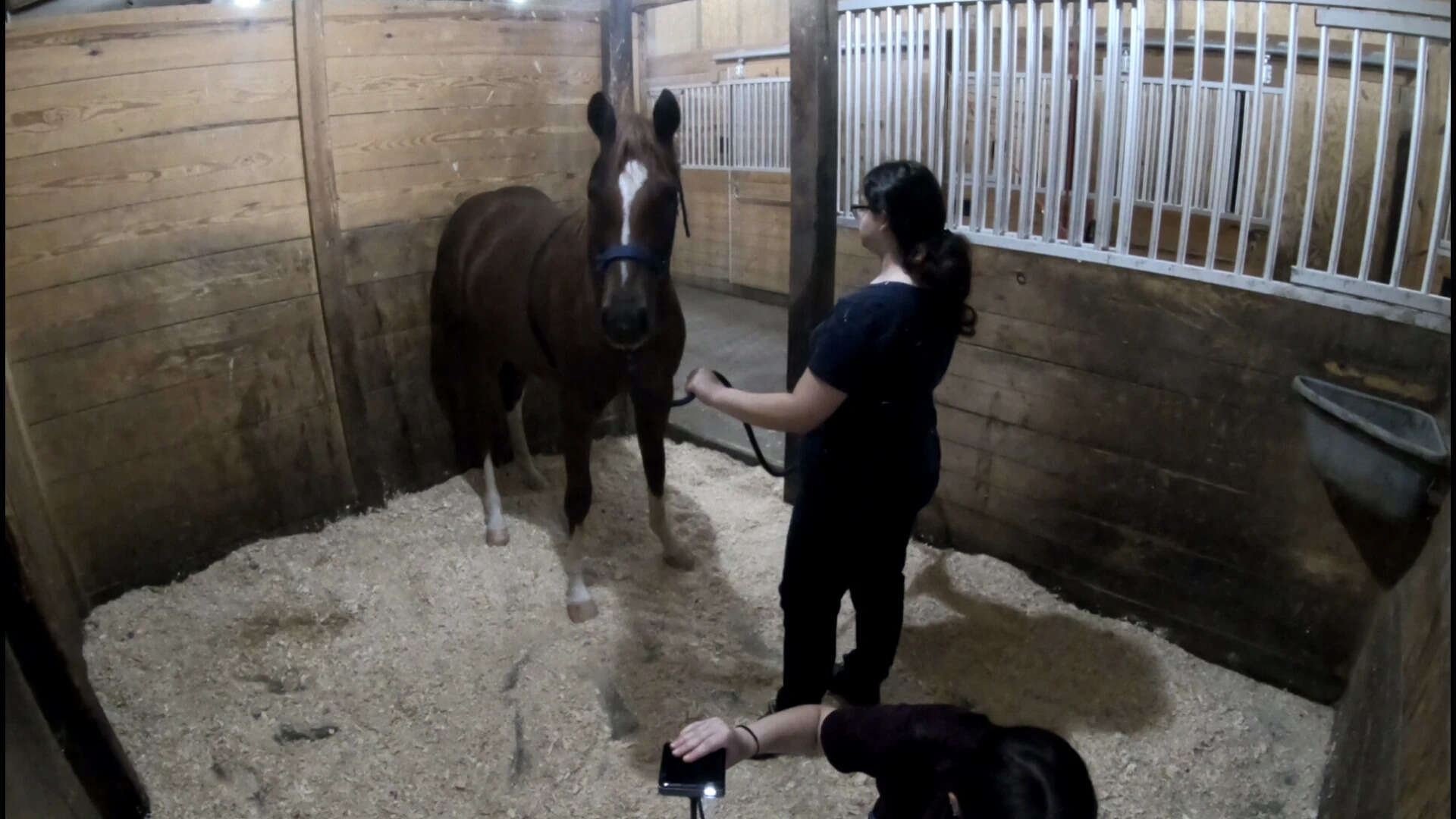
A handler holds onto a horse while a researcher sets up the projector and videos. Credit: Zeynep Benderlioglu
Cognitive processing over primitive reflex
The horses’ eye movements gave researchers more clues about how they process danger. Earlier veterinary studies suggest that vertebrates usually look at threats with the left eye so the information is processed by the right side of the brain, which controls fast emotional responses. Looking with the right eye is generally linked to the left side of the brain, which handles more careful thinking.When watching the wolves, the horses showed no clear preference for either eye. While watching the harmless wombats, they looked straight ahead with both eyes at the same time.“They were investigating, it seems. The point is, they’re assessing immediately, within 20 seconds,” Benderlioglu explained. “You cannot be in the horse’s head, but its gaze and heart are giving something away. It’s like the horse thinks, ‘Here is a wolf.’ Wait a minute, the horse thinks again, ‘What is that fluffy thing?'”This quick visual assessment challenges the common belief that prey animals depend only on panic and the instinct to run away. Because the threat stayed on a screen and never entered the room, the horses appeared to control their physical reactions while carefully judging the danger.
Guarding against the invisible threat
The findings are an important reminder for riders and handlers who work with horses around dogs or other canines.“This visual recognition means horses may be experiencing an internal state of agitation while remaining physically still,” Benderlioglu said. “Understanding this disconnect is vital for ensuring both rider safety and the welfare of a horse that is processing a threat, especially if that threat is a canid—any dog.”If a handler cannot recognise these hidden signs of stress, they could unknowingly push an already anxious horse to a dangerous breaking point.The research was co-authored by Ohio State researchers Rachel Hofacker, Natalie Sebunia, who has since joined Cornell University, and Jessica Pihlblad, who is now based at the University of Arizona.