
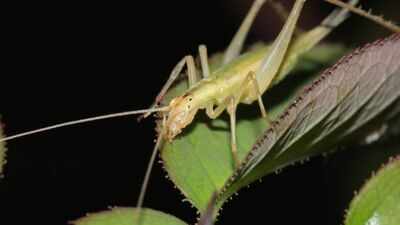
For 165 million years, the sounds made by insects living alongside dinosaurs were lost to time. Scientists have now recreated some of those calls using fossilised wings, studies of living insects, computer modelling and artificial intelligence.According to Smithsonian Magazine, the research focused on nine extinct insect species related to modern crickets and katydids. The team studied 20 fossil specimens found in Inner Mongolia, China. The fossils preserved important details of the insects’ wings, including structures that were used to produce sound.Researchers say the results offer the best evidence-based approximation so far of what part of a Jurassic forest may have sounded like. Their work was published on August 25 in the Proceedings of the National Academy of Sciences, along with audio samples of the reconstructed calls.The work also revealed something unexpected. One of the insects, Sigmaboilus peregrinus, appears to have produced sounds between 20 and 22 kilohertz. That is at or above the upper limit of human hearing and means some Jurassic insects may already have been using ultrasonic communication.
How Jurassic insects communicated
Unlike humans, crickets, grasshoppers and katydids do not use vocal cords to produce their familiar calls. They use a process called stridulation, which involves rubbing body parts with ridged surfaces against each other.In modern grasshoppers and katydids, a leg can be dragged across a wing. Crickets usually move one wing across the other. The Jurassic insects studied by the researchers had similar structures on their wings.One wing had comb-like ridges, while the other had a scraping structure. When the two surfaces moved against each other, the scraper caught the ridges and produced a series of rapid clicks. These clicks blended together into a continuous chirp.The exact structure of the wings affected the sound. The number and spacing of the ridges, along with the size of the area that vibrated, helped determine the pitch and rhythm of each call.That made the fossilised wings especially useful to scientists. “The beauty of fossil insects is that they can preserve their instruments and receptors on their tough external skeleton, unlike many other animals,” Edmund Jarzembowski, an associate scientist at London’s Natural History Museum who was not involved in the study, told Smithsonian magazine.
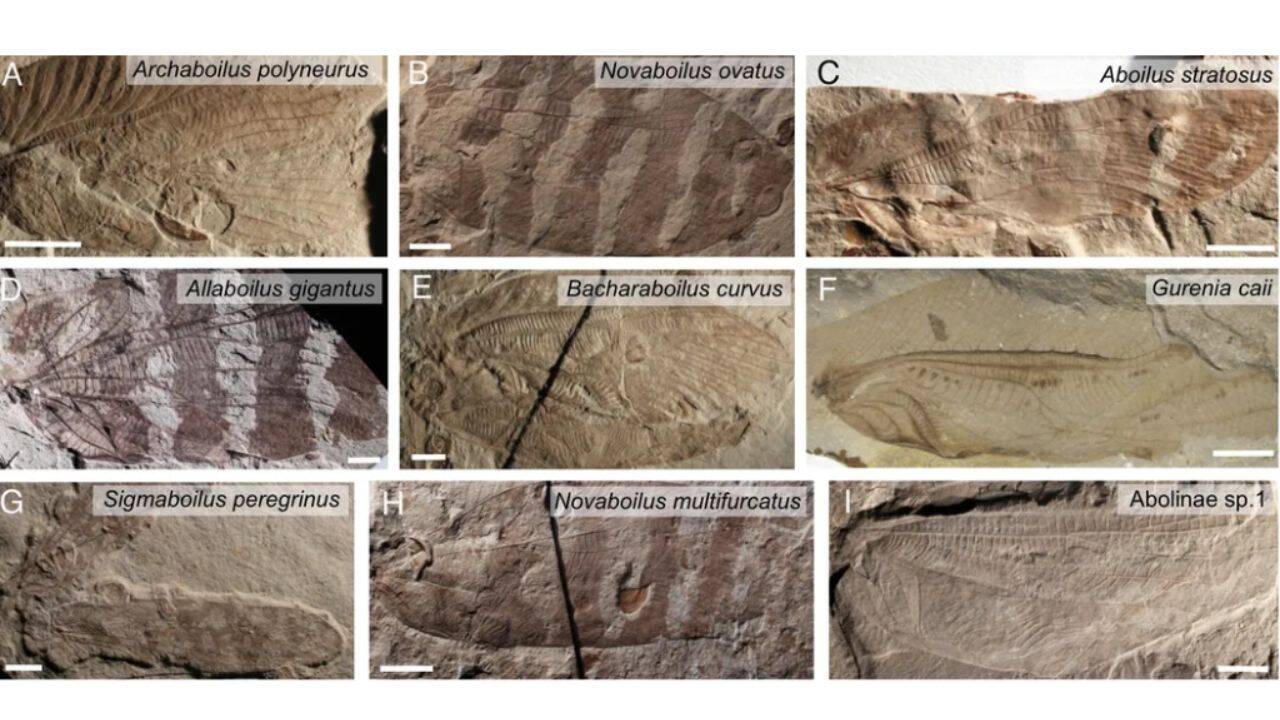
The team studied 20 fossil specimens found in Inner Mongolia, China.
Lasers helped reconstruct calls
The scientists first studied how living insects produce sound. They used high-speed cameras and a technique called laser Doppler vibrometry to measure how modern insects’ wings moved and vibrated during stridulation.Those measurements were then used to build and test a computer model. The model showed how differences in wing structures could affect the sounds produced by the insects.The researchers then created two-dimensional models of the fossilised wings and fed their structural information into the computer model. They also considered the evolutionary relationships between the extinct insects and their living relatives.Machine learning was then used to help predict the patterns of the ancient calls. The process produced nine different reconstructed sounds linked to the nine fossil species.Most of the insects appear to have produced relatively low-frequency calls, similar to those made by modern crickets. Their calls were around five kilohertz. Many were described as “pure tone” sounds, meaning they were mainly made up of one frequency.The result would have been clear, high-pitched chirps rather than the hissing or buzzing sounds people may associate with some insects.
Calls above human hearing
The most striking finding came from Sigmaboilus peregrinus. The researchers’ reconstruction suggested that it could produce a call between 20 and 22 kilohertz.Humans generally hear sounds from about 20 hertz to 20 kilohertz. Sounds above that range are known as ultrasonic sounds.“The first time we reconstructed the song and saw it was over 20 kilohertz, we were so excited,” Jun-Jie Gu, a professor of entomology at Sichuan Agricultural University, said, as quoted by New York Times.The finding challenges a long-standing explanation for why some insects evolved ultrasonic communication. Scientists have suggested that bats may have driven the development of these high-frequency calls because insects could use them to communicate while avoiding predators.But bats appeared on Earth roughly 100 million years after the end of the Jurassic. That means they could not have been responsible for the development of ultrasonic calls in these much older insects.Gu and his colleagues instead suggest that Jurassic insects may have had other reasons to use higher frequencies. One possibility was avoiding predators such as early mammals and other animals.Another was competition between insects. If many species were calling at the same frequency, their signals could have become difficult to distinguish.Gu said the insects may have wanted to “have their own channels”. He added that “165 million years ago, the insect community may have already had sophisticated acoustic niches- multiple species occupying different frequency bands from low to high”.Researchers say the work could also help scientists reconstruct sounds made by other extinct insects. Jarzembowski suggested that AI could eventually be used to study ancient beetles and ants as well.“Perhaps AI will help us reconstruct other insect songs, too,” he said. “Let’s look more closely at their fossils, as there’s a potential paleo-orchestra to be discovered.”Gu said the research could also help create more scientifically accurate portrayals of the Jurassic. His team worked with the creators of a new Netflix documentary mini-series, “The Dinosaurs”, to add reconstructed insect sounds to its Jurassic scenes.Thomas Land, a zoologist who worked as a researcher on the series, said the insect sounds helped create a more accurate Jurassic setting. “It’s such a small detail,” he said, “but we did it because every choice like that makes the whole much more realistic.”