
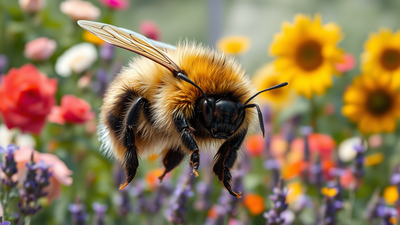
Anyone who has watched a large, heavy-bodied bee moving slowly from flower to flower on a hot day has seen an insect working far harder than it looks. New research suggests these bigger bees are now facing a growing threat tied directly to rising carbon dioxide levels in the atmosphere. As CO2 from burning petrol, coal and gas continues to build up, large-bodied bees are becoming smaller, less genetically diverse and harder to find in high CO2 environments, while smaller bees appear to be coping far better with the same conditions. Since large bees are especially effective at pollinating certain plants, their decline carries consequences that reach well beyond the insects themselves.
Rising CO2 is quietly changing the food bees depend on
Flowers give bees two essential things, pollen and nectar. Pollen is a bee’s only natural source of protein, and it is essential for feeding and raising young bees. Nectar provides the sugar bees rely on for energy. As carbon dioxide levels in the atmosphere continue to rise, largely from burning petrol, coal and gas, scientists have found that this basic food supply is changing in ways that affect how well bees are fed.
What a Purdue-led study found in goldenrod pollen
A peer-reviewed study titled Rising atmospheric CO2 is reducing the protein concentration of a floral pollen source essential for North American bees, published in Proceedings of the Royal Society B, examined goldenrod, a common North American plant that blooms late in the season and provides bees with some of the last available pollen before winter. The researchers compared the protein content of goldenrod pollen collected recently with samples preserved from earlier periods, going back to the start of the Industrial Revolution. They found that the overall protein concentration in goldenrod pollen had fallen by around one third over that time span, a decline the study links to rising atmospheric CO2 levels acting on the plant itself.
Why this decline matters for bees specifically
Pollen quality is not a minor detail in a bee’s diet. Since pollen is the sole source of protein for both wild bees and honeybees, and plays a direct role in larval development, a steady drop in its protein content over time represents a genuine reduction in food quality for bees relying on this plant. The study’s authors describe this as a previously unexamined side effect of rising CO2, since earlier research had already shown that CO2 lowers the nutritional value of major human food crops such as wheat and rice, but this was the first study to demonstrate a comparable effect in a plant bees actually depend on for food.
Why goldenrod’s timing makes this especially significant
Goldenrod’s role as a late-season food source adds extra weight to this finding. In northern regions of North America, very little pollen remains available once autumn arrives, making goldenrod one of the final significant food sources bees can access before winter. A decline in the nutritional quality of this particular plant’s pollen affects bees at a critical point in their yearly cycle, when they are trying to build up reserves needed to survive the colder months ahead.
Do you believe that the decline in pollen quality is a significant threat to bee populations?
3k+ users shared opinion today
5k+ users already voted today
3k+ users shared opinion today
One pressure among several already facing bees
This nutritional decline does not act in isolation. Bee populations already face a range of well-documented pressures, including diseases and parasites such as deformed wing virus, Varroa mites and Nosema fungi, along with habitat loss and exposure to pesticides. According to data cited in the study from the United States Department of Agriculture’s Agricultural Research Service, annual losses of managed honeybee colonies in the United States averaged around 33 per cent per year between 2006 and 2011. A decline in pollen quality adds an additional layer of stress on top of these existing challenges, rather than acting as a single, standalone threat.
Why the wider implications extend beyond bees
The study’s authors note that this same pattern, elevated CO2 diluting a plant’s protein content by encouraging faster growth without a matching increase in nutrient uptake, has already been documented in staple human food crops. Finding a similar effect in a plant that forms a critical part of the bee diet suggests this is not an isolated case limited to one type of pollen, and the study’s authors describe this as one of several new lines of evidence pointing to broader effects of rising CO2 on plant-based food systems, both human and animal.
What the researchers say still needs to be studied
The study makes clear that its findings are specific to goldenrod, and its authors are cautious about extending the conclusion to every flowering plant bees rely on. Determining how widespread this effect is across other important pollen and nectar sources remains an open area for further research, and the study’s authors note this gap directly, stating that continued investigation is needed to understand how consistently rising CO2 levels are altering the nutritional quality of the wider range of plants that bee populations depend on throughout the year.