
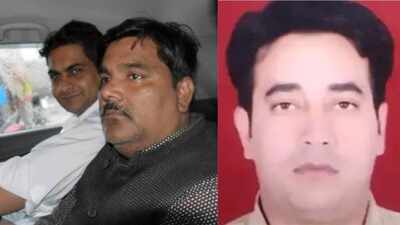
NEW DELHI: Bringing the six-year-long trial in the murder of Intelligence Bureau staffer Ankit Sharma to a close, a Delhi court on Friday sentenced former AAP councillor Tahir Hussain and four others to life imprisonment, holding that Sharma was lynched “solely on account of his religion” during the 2020 northeast Delhi riots.Additional sessions judge Parveen Kumar Singh, however, declined the prosecution’s plea for the death penalty, ruling that while the brutality of the crime was undeniable, the prosecution had failed to prove any specific act committed by each convict during the murder.Pronouncing the sentence, Singh described the murder as one of exceptional brutality committed during the “communal violence that erupted in the wake of the protests against CAA/NRC”.The court held that the prosecution failed to prove allegations that Hussain had “aided, abetted, instigated or led the unlawful assembly”. Singh rejected the other convicts’ pleas that they were sole breadwinners. However, he did consider their educational background as a mitigating factor.On July 13, the court had convicted Hussain and four others, holding that the five were part of “a large crowd which, with animus against Hindus, had assembled… with a common object to commit rioting, loot, arson and to cause damage to the property and person of members of the Hindu community”, before murdering the IB staffer on Feb 25, 2020, whose body was later recovered from a drain.
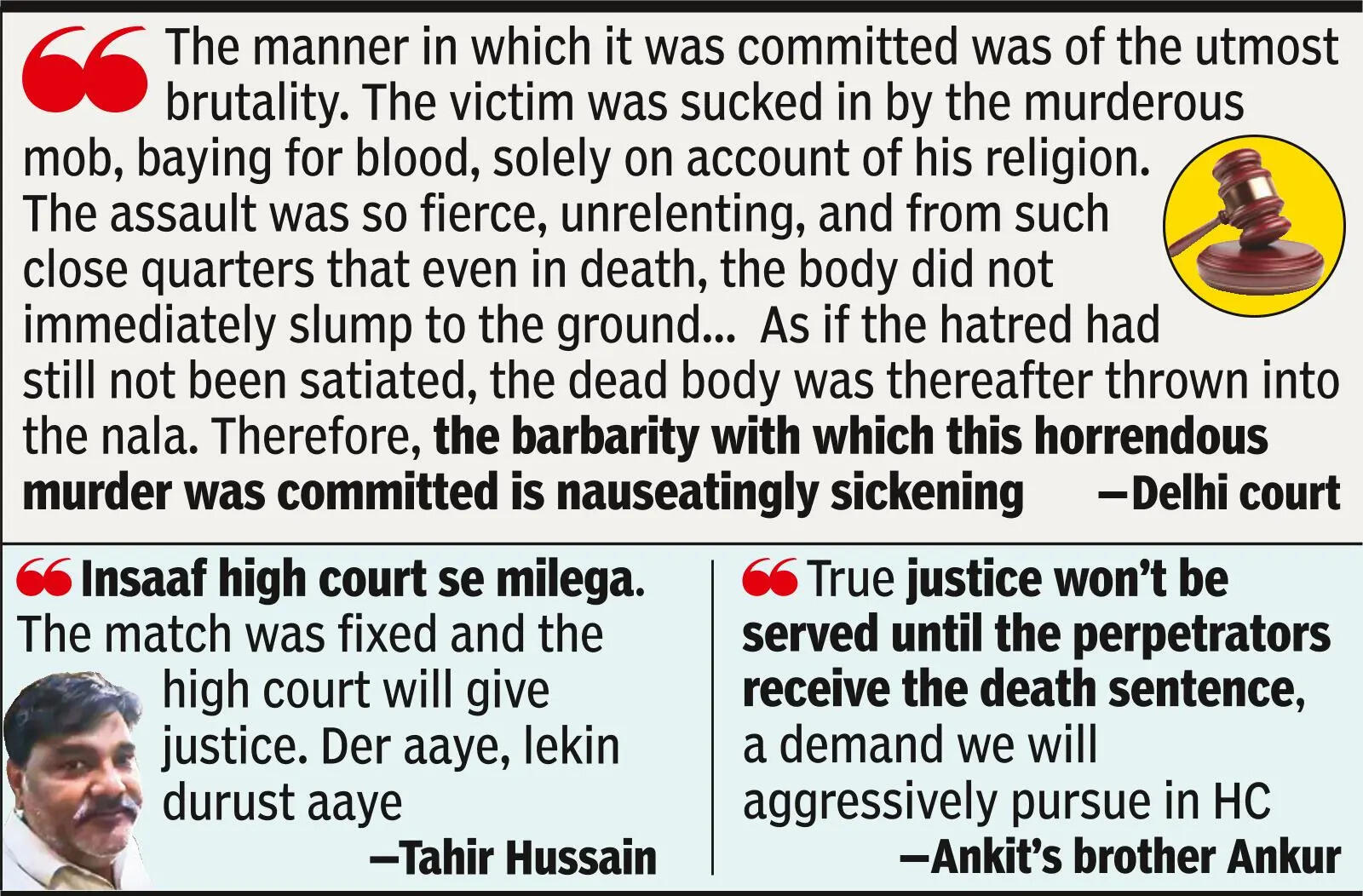
‘Only death sentence will be justice’Hussain was sentenced to six months’ RI under IPC Section 188, three years under Section 153A, two years under Section 147, three years under Section 148, seven years under Section 365 and imprisonment for life under Section 302. All sentences will run concurrently. He was also fined Rs 1,000 under Section 188, Rs 20,000 each under Sections 153A, 147 and 148, Rs 50,000 under Section 365 and Rs 5 lakh under Section 302, with default sentences in case of non-payment.“The manner in which it was committed was of the utmost brutality. The victim was sucked in by the murderous mob, baying for blood… The assault was so fierce, unrelenting, and from such close quarters that even in death, the body did not immediately slump to the ground,” the judge held.The court noted that the violence did not end with Sharma’s death. His body, it observed, was strapped “like an animal”, dragged to Chand Bagh pulia and thrown into a drain. Calling it an “aggravating circumstance of immense magnitude”, the judge remarked, “As if the hatred had still not been satiated, the dead body was thereafter thrown into the nala. Therefore, the barbarity with which this horrendous murder was committed is nauseatingly sickening.”Saying the “crime test” tilted the case towards the “rarest of rare” category, the judge weighed aggravating and mitigating circumst-ances before declining the capital punishment sought by special public prosecutor Madhukar Pandey, who maintained that the offence was part of “well-orchestrated communal violence” rather than a crime committed und-er sudden provocation.The court zoomed in on what it found to be the prosecution’s principal shortcoming — the lack of specificity regarding the individual role of each convict. Observing that “before a life is ordered to be extinguished by a judicial decree”, something more than mere membership of an unlawful assembly had to be proved, the judge held that the prosecution had failed to bridge that gap. While acknowledging the state’s contention that the use of a heavy cutting weapon reflected pre-planned and cold-blooded intent, the court said the time for drawing such inferences was long past and treated the lack of specificity as a “huge mitigation.”Judge Singh rejected the convicts’ pleas that they were sole breadwinners and noted that the “monstrosity of the crime committed outweighs this mitigating circumstance”. At the same time, he found no material to conclude that they were beyond reform.It also noted that allegations of Hussain’s house being used as a “launchpad” for the riots were neither part of the charges framed nor specifically proved during trial. The judge also took note of the “entirely satisfactory” custodial conduct of Hussain, Kasim and Nazim, barring minor infractions by Kasim.Another mitigating factor, the court said, was the educational background of the convicts. It observed that “vested interests” had spread misinformation and whipped up a “religious frenzy”, making the uneducated co-convicts “more gullible and susceptible to such propaganda”, and held that this vulnerability to manipulation was relevant while determining the sentence.Hussain’s co-convicts were awarded life imprisonment under Section 302 IPC with a fine of Rs 25,000 each. They were also sentenced to six months under Section 188, three years under Section 153A, two years under Section 147, three years under Section 148 and seven years under Section 365 IPC, along with fines ranging from Rs 1,000 to Rs 10,000 under the respective provisions. All the sentences will run concurrently.
Share your thoughts in the comments
Be respectful · TOI community guidelines
As Hussain was being led out of the courtroom by police after the sentencing, he turned to those present and said, “High court se insaaf milega. Der aaye, lekin durust aaye.”Speaking to TOI, Ankur Sharma, brother of the IB staffer, said, “From day one, this has been a ‘rarest of rare’ case. While we appreciate that the trial court has delivered a conviction and handed down life imprisonment, true justice won’t be served until the perpetrators receive the death sentence, a demand we will aggressively pursue in the high court. The sheer brutality of the crime still haunts our family every single day; knowing he was inflicted with 51 wounds, subjected to acid, and dumped in a drain is a pain that never truly goes away.”