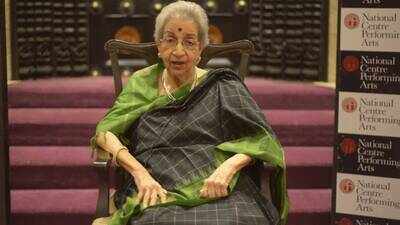
Veteran theatre director, actor and producer Vijaya Mehta, one of the most influential figures in modern Marathi theatre, passed away on Tuesday at the age of 91. She breathed her last at her residence, leaving behind a rich legacy that transformed the landscape of Indian theatre.“She passed away around 9:30-10 pm. I learnt about her demise through her daughter. It’s a personal loss. She has been my guru,” actor Vijay Kenkre, who served as chief assistant on the veteran filmmaker’s 90s TV serial “Lifeline” and worked closely with her on several other projects, told PTI. Fondly known as “Bai” within theatre circles, Mehta’s demise has cast a pall of gloom over the Marathi film and theatre fraternity, with artists and admirers remembering her as a pioneering force who redefined stagecraft and storytelling.
A pioneer of Marathi experimental theatre
Born as Vijaya Jaywant on November 4, 1934, in Baroda (now Vadodara), Gujarat, Mehta graduated from the University of Mumbai and trained under legendary theatre practitioners Ebrahim Alkazi and Adi Marzban. Her rigorous grounding in theatre would later help shape one of the most significant artistic movements in post-Independence India.In the 1960s, she co-founded the groundbreaking theatre group Rangayan alongside playwright Vijay Tendulkar and actors Shriram Lagoo and Arvind Deshpande. The group became a driving force behind Maharashtra’s experimental theatre movement, challenging conventional commercial theatre and introducing bold, contemporary narratives.
Landmark productions that changed Indian theatre
Mehta’s stage adaptation of C. T. Khanolkar’s Ek Shoonya Bajirao is widely regarded as a landmark in contemporary Indian theatre. She also introduced the works of Bertolt Brecht to Marathi audiences through her acclaimed adaptation of The Caucasian Chalk Circle, titled Ajab Nyay Vartulacha. Her productions of Barrister, Shakuntal, Hamidabaichi Kothi and Mother remain celebrated for their innovation and artistic depth.Her contributions extended beyond India through collaborations on Indo-German theatre projects with international artists, helping introduce Indian theatre to wider global audiences.
Acclaimed work in cinema
While theatre remained her first love, Vijaya Mehta also made a lasting impact on Indian parallel cinema. She appeared in acclaimed films such as Kalyug and Party, earning widespread praise for her performances.As a filmmaker, she directed notable works including Rao Saheb and Pestonjee, both of which are regarded as significant contributions to India’s parallel cinema movement.
A career honoured with prestigious awards
Over a career spanning more than six decades, Mehta received numerous honours. She was awarded the Sangeet Natak Akademi Award for Direction in 1975 and was later honoured with the META Lifetime Achievement Award in recognition of her immense contribution to Indian theatre. She also received the Padma Shri in 1986, won the National Film Award for Best Supporting Actress for Rao Saheb, the Best Actress award at the Asia Pacific Film Festival for Party, and was conferred the Sangeet Natak Akademi Tagore Ratna in 2012.