
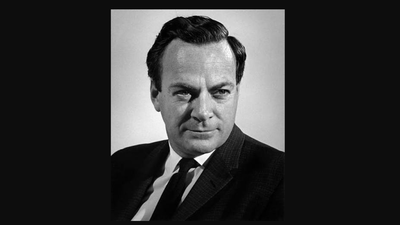
Two people can read the same explanation of something and walk away with completely different levels of confidence in what they actually know. One nods along, follows the logic, and quietly assumes that following along counts as understanding. The other insists on rebuilding the idea from scratch, alone, without notes or references, and treats any point where that rebuilding breaks down as proof that the earlier understanding was never fully real to begin with. Richard Feynman, the physicist known as much for his gift for clear explanation as for his work on quantum electrodynamics, belonged unmistakably to the 2nd group. He wrote this exact line on his own blackboard, found there still after his death in 1988, not as advice meant for any audience but as a private, working standard he held himself to across his entire career, one that treated real comprehension as something proven only by construction, never by mere familiarity with someone else’s account of it.
Quote of the day by Richard Feynman
“What I cannot create, I do not understand.”
Written by a physicist who tested his own explanations in public
This idea carries particular weight coming from someone who put it to very public use, more than once. When Feynman served on the panel investigating the 1986 Space Shuttle Challenger disaster, he grew frustrated with technical testimony that explained the O-ring failure in vague, hedged, bureaucratic language rather than in terms anyone watching could actually verify for themselves. During a televised hearing, he took a small piece of the seal material, clamped it, and dropped it into a glass of ice water in front of the committee, showing within seconds exactly how the cold made the rubber lose its resilience and fail to seal properly, a mechanism that months of official testimony and internal paperwork had somehow failed to make plainly clear to the public. He would not accept the explanation secondhand until he had rebuilt the failure himself, with material he could hold in his own hand, in front of the cameras and everyone watching.That same instinct shaped his teaching decades earlier. As a professor at Caltech, Feynman became known for refusing to let a complicated idea stand simply because a textbook or a senior colleague had already validated it. He would instead work through the concept from first principles until he could explain it in language a beginner could follow, a habit that eventually became known outside physics as the Feynman Technique, in which a person tries to explain an idea in plain terms as though teaching it to someone with no background at all, and treats every stumble in that explanation as a precise, honest map of what they don’t actually understand yet.
A simple way to actually use this idea
The line endures because it names something most people quietly avoid confronting: that comfort with an idea and mastery of an idea are not the same thing, and that only one of the two actually survives being tested under pressure. It is entirely possible to sit through a lecture, finish a book, or watch an explainer video and feel a genuine sense of clarity, only to discover, the moment you try to reproduce the idea unaided, that the clarity was borrowed rather than earned. Feynman’s standard closes that gap by making the test unavoidable: either you can build it, or you can’t, and no amount of familiarity with someone else’s version changes which of those is true.A fair way to use it is to periodically try explaining or rebuilding something you assume you already understand, without referring back to the original source, and to treat every place the explanation breaks down not as an embarrassing gap to smooth over, but as the actual, honest edge of your knowledge, worth returning to before moving on to anything more advanced. This works as well for a skill at work as it does for a physics equation. The discomfort of hitting that edge is not a sign the method has failed. It is the method working exactly as intended.
Other famous quotes by Richard Feynman
- “I would rather have questions that can’t be answered than answers that can’t be questioned.”
- “The first principle is that you must not fool yourself, and you are the easiest person to fool.”
- “Study hard what interests you the most in the most undisciplined, irreverent and original manner possible.”