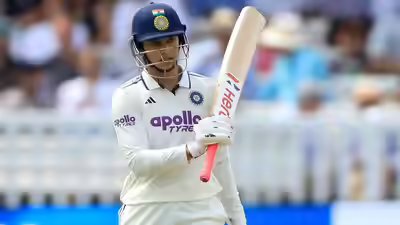
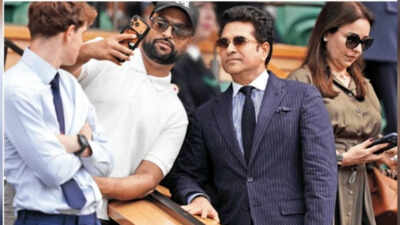
Wimbledon is a great place to stargaze — from Hollywood and Bollywood to musicians, royalty, sporting icons and the fashion elite. For an Indian walking the grounds in southwest London this past fortnight, there was another striking sight: the sheer number of familiar faces from home.Indian cricket captain Shubman Gill seemed to be everywhere. One moment, he was chatting with Roger Federer, whose post-retirement reinvention as a style icon has only added to his allure. Photographs of the duo swept across social media. Next, Gill was in the Royal Box alongside Sachin Tendulkar and his wife Anjali.
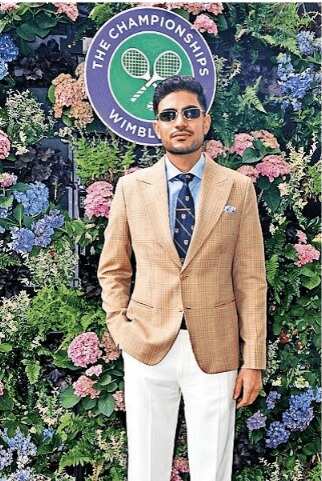
Shubman Gill
Wimbledon dubbed Gill the “Prince of Indian cricket”. In an interview with the hosts, Gill returned the compliment, calling Jannik Sinner and Carlos Alcaraz, both two-time champions here, the “princes of tennis”.Gill picked Federer as his greatest tennis inspiration.“People associate him with being very effortless,” he said. “When I started playing cricket, people also used to call me effortless, but then, you know, how much effort goes into making it look effortless to people.”
Beyond the baseline
For India’s sporting and entertainment elite, Wimbledon has become more than a tennis tournament. It is one of the rare sporting events that occupies the same cultural space as a fashion week or a Hollywood premiere. Over the fortnight, the grounds drew figures such as Anna Wintour, Jennifer Lopez, Lily Collins, Tom Hiddleston, Nicole Kidman and Benedict Cumberbatch, among others.Wimbledon has become as much a place to be seen as a place to watch tennis, in a way that Melbourne, Paris and New York have yet to replicate.Which raises the obvious question: why has Wimbledon become the Grand Slam that Indian celebrities increasingly want to attach themselves to? According to Sally Bolton, chief executive officer of the All England Lawn Tennis Club, that growing visibility is no accident. In its bid to reach new audiences at home and abroad, Wimbledon has consciously broadened its appeal beyond tennis.“That’s how we’ve used the intersectionality of sport with culture, fashion, celebrity,” Bolton told TOI. “It’s using that space, talking about The Championships to a new audience, who might not be natural tennis fans, and who might grow an affinity for Wimbledon for reasons that go beyond the tennis.”The strategy has produced striking results in India.“I remember we had Rohit Sharma and Sachin Tendulkar here in 2024,” Bolton said. “They were in the Royal Box and they posted a few pictures on social media. The scale of engagement we got from what was a relatively simple thing was enormous in India. People who may never have really thought about tennis before, that kind of gave them a reason to ask, what is Wimbledon? And might I be interested in that?”Indian cricketers at Wimbledon are hardly a new phenomenon. In Cricket Delightful, Mushtaq Ali wrote that the Indian team touring Britain in 1936 was invited to Wimbledon, where its members watched Fred Perry in action. That was 90 years ago.The faces have changed, but the fascination remains.
Tennis Lifers
Ask Ravi Shastri, the cricketer-turned-coach-turned-commentator for whom tennis was his first sport.“I played tennis first and then shifted to cricket,” he said. “I knew as much about tennis records as I knew about cricket records of the 70s. Even now, I follow tennis.”Shastri has been coming to Wimbledon since 1982, when Jimmy Connors and Martina Navratilova won the singles titles. In 2019, he was seated behind the umpire’s chair during the men’s final, in which Roger Federer lost to Novak Djokovic after holding two championship points.Shastri, then coach of the Indian cricket team, was seated almost level with the court and was struck by the sound and speed of the game.“You see how hard they hit the ball. And how it flies, you watch their footwork, the way they move. It was unbelievable,” he said.Having attended three of the four Grand Slams, including the Australian Open and Roland Garros, Shastri places Wimbledon above the rest.“It has tradition, it has history; the rules don’t bend that easily there,” he said. “Strawberries and cream, Pimms… and every time you go there, it grows on you more. It’s something different. You know that right from the moment you walk through that gate and enter the grounds. It is a whole different vibe.”
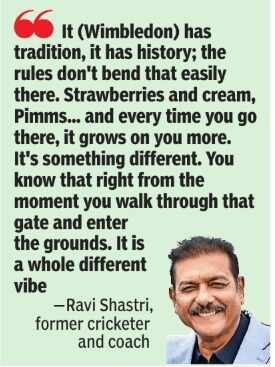
Ravi Shastri
For Lara Dutta Bhupathi, Miss Universe 2000 and actor, Wimbledon also represents something more personal. Her connection comes through her husband, Mahesh Bhupathi, who won three Wimbledon titles — one in men’s doubles and two in mixed doubles.“My introduction to Wimbledon is very different from the others in Bollywood,” Lara said.Each summer, Mahesh, Lara and their daughter Saira make what has become an annual pilgrimage to SW19.“It’s a different feeling now when we walk around the grounds. As I walked past the player restaurant, I remember Saira was crawling around the place then. She’s 15 now and plays tennis,” Lara said. “But every summer we are here for our tennis fix.”
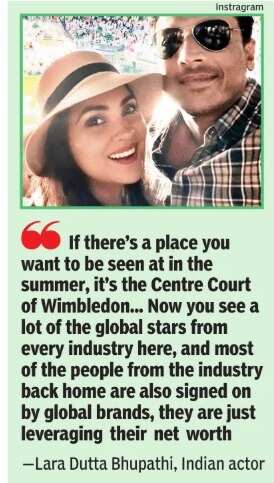
Lara Dutta
Centre court cachet
But Lara is also clear-eyed about what draws much of the wider celebrity crowd.“If there’s a place you want to be seen at in the summer, it’s the Centre Court of Wimbledon,” she said. “Now you see a lot of the global stars from every industry here, and most of the people from the industry back home are also signed on by global brands, they are just leveraging their net worth.”This year’s Indian contingent included Priyanka Chopra, Ananya Panday, Deepti Sharma, Abhishek Sharma, Sanju Samson, Yuvraj Singh, Ayesha Khan, Archana Puran Singh, Sreeleela and Kalyani Priyadarshan, among others.

Sanju Samson
Priyanka, beauty queen, actor and, more recently, style icon, arrived in a ruffled Toni Maticevski dress and delighted fans by FaceTiming her husband, Nick Jonas, from Centre Court.
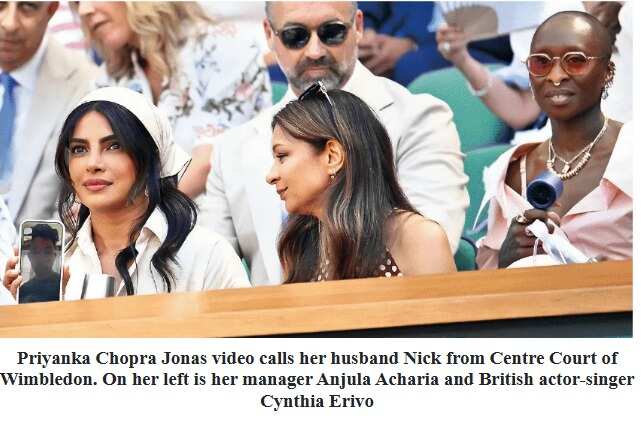
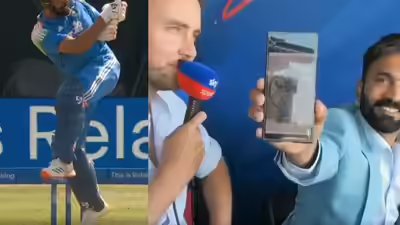
Priyanka Chopra Jonas video calls her husband Nick from Centre Court of Wimbledon. On her left is her manager Anjula Acharia and British actor-singer Cynthia Erivo.
“Usually he accompanies me to Wimbledon,” she explained to Indian tennis legend Vijay Amritraj during a chat. “He’s a big fan; he wasn’t able to do that. He is back home in LA, so I just did a three-second video.”The video promptly went viral.The celebrity carousel now extends beyond film stars and cricketers. Wimbledon has also become a destination for influencers and social media personalities, who pose beside trophies, smile for endless photographs, sip Pimm’s — the signature cocktail of The Championships — and broadcast the experience to thousands of followers.Their reels offer guides to what to wear, where to pose and what to eat at Wimbledon — though not necessarily whom to watch.
Part Of The spectacle
At a tournament without courtside advertising hoardings, the people themselves have become part of the spectacle.Bolton said the same thinking lies behind Wimbledon’s engagement with influencers.“It’s about taking opportunities to get to new and different audiences. By using those that have access to that audience.”That, ultimately, is Wimbledon’s peculiar achievement. It can be a branding opportunity, a fashion statement, a family tradition and a sporting pilgrimage all at once. The celebrity arrivals and social-media posts may draw new audiences through the gates, but the tournament’s history and atmosphere give them a reason to return.