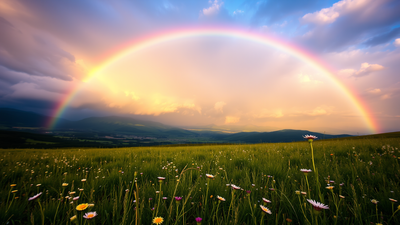
Whenever you spot a rainbow stretching across the sky after a monsoon shower, you think you’re seeing the same arc of colours as everyone around you. But here’s what science reveals: that rainbow is yours alone. Every person viewing what appears to be the same rainbow is actually seeing a completely different one, formed by different raindrops and positioned differently in the sky. Even standing right next to a friend watching the identical stretch of sky, the rainbow they see is technically different from yours. This happens because rainbows aren’t fixed objects hovering at a specific location; they’re optical phenomena created by the unique geometric relationship between your eyes, the sun’s position, and the water droplets floating in the air. According to Physics Reports, each person literally has their own personal rainbow, and no two observers anywhere in the world share the same one.
Why your rainbow is uniquely yours
A rainbow seems to occupy a real place in the sky. You can point to where it starts near the treeline and trace it as it arcs across the field before disappearing toward the horizon. Walk toward it, and it moves away. Walk backwards, and it follows you. This behaviour confused people for centuries until physicists worked out what was actually happening. The rainbow isn’t moving at all; it’s simply being formed by different raindrops as your position changes.The key to understanding personal rainbows lies in the “antisolar point.” This is an imaginary spot in the sky located directly behind you, opposite where the sun is shining. Your own shadow falls on this point. Every raindrop that forms your rainbow sits on an invisible cone extending from your eye at precisely 42 degrees from this antisolar point. Your friend standing just one meter away has their own antisolar point, and their invisible cone passes through entirely different raindrops. According to National Geographic’s research on rainbow formation, this means each person has a different antisolar point, and therefore a different horizon from which their rainbow appears to end. The rainbow that seems to end at the trees for you ends somewhere completely different for your friend.
The physics behind the 42-degree rainbow angle
The number 42 appears in every primary rainbow that ever forms on Earth, and it’s not a coincidence. It’s a fundamental property of how water refracts light. When sunlight enters a spherical raindrop, it slows down and bends as it passes from air into water, a process called refraction. The light then bounces off the back curved surface of the raindrop, reflecting internally. As it exits the raindrop, it bends a second time.The crucial detail is that different colours of light bend by different amounts. This happens because water’s refractive index (a measure of how much it bends light) varies depending on the wavelength of light. Red light, with its longer wavelength, bends slightly less than violet light. The result is that white sunlight entering a raindrop emerges as separated colours. The dominant beam of light that produces the visible rainbow deviates from its original path by approximately 138 degrees. When you measure the angle from your eye to the raindrop and then to the antisolar point, it works out to roughly 42 degrees.This angle has remained constant throughout human history. A rainbow seen today in Delhi and one observed in ancient Greece two thousand years ago are geometrically identical at the level of angle, even though they involved completely different raindrops separated by thousands of kilometers and centuries. The secondary rainbow, that fainter arc sometimes visible outside the primary, forms at about 51 degrees from the antisolar point because light reflects twice inside each raindrop instead of once, which is why it’s dimmer and has colours in reverse order.
How light bends and creates colours in rainbows
Understanding rainbow colours requires understanding refraction. When white sunlight enters a raindrop, the different wavelengths that make up visible light respond differently to the water. Violet light, with its short wavelength, bends more sharply than red light with its longer wavelength. This spreading of light into its component colours is what creates the familiar sequence from red on the outside of the rainbow to violet on the inside.The reason you see this sequence across the arc relates to the angle. Raindrops that refract violet light back toward your eye are positioned at slightly smaller angles from the antisolar point, while raindrops sending red light to your eyes sit at slightly larger angles. The complete spectrum appears because you’re viewing this light-bending process at different angles across the entire cone. Every raindrop contributes light at the angle it occupies, and billions of drops together create the seamless arc you see.
The geometry of personal rainbows: Even your eyes see different rainbows
Here’s something even more surprising: your left eye and right eye are seeing slightly different rainbows. The space between your eyes is roughly six centimetres. The two invisible cones extending from each eye pass through different raindrops. Your brain fuses these two slightly different optical phenomena into a single perceived image, just as it combines two slightly different views of any object into three-dimensional depth perception. The fusion is so seamless that you’re completely unaware that the underlying images are different. If you close one eye and then the other, you’re technically looking at two distinct rainbows.This explains why your eyes also perceive distance cues from rainbows, or rather why they don’t perceive them effectively. Because rainbows at 42 degrees could be formed by raindrops at nearly any distance away, your brain can’t determine how far away the rainbow actually is. Raindrops close to you and raindrops far away both contribute light at the same angle. This is why rainbows seem to float at an indefinite distance.
What science actually reveals about rainbow formation and how rainbows behave
When you move toward a rainbow, you don’t actually move closer to it; instead, the set of raindrops forming it changes. Raindrops that were at the correct 42-degree angle relative to your old position fall outside this angle when you move. New raindrops that weren’t at the angle before are now. The rainbow appears to retreat because it’s being continuously reformed by a changing set of water droplets. The phenomenon isn’t magical or mysterious; it’s pure geometry.The practical result is that a rainbow is the deepest personal experience of physics. It’s centred on a point that exists only relative to you. It’s built from raindrops that no other observer in the world is using to form their rainbow. It looks like a tangible thing in the sky because your brain is excellent at extracting object-shaped patterns from sensory information, but the underlying physics describes not an object but a geometric relationship.Even as you stand still watching a rainbow, you’re looking at a different one moment to moment as raindrops fall and new ones move into position. The rainbow you see is yours alone, visible to no one else on Earth, and constantly changing even as you watch it. That’s not just physics, that’s poetry.