Vijayawada: Chief minister N Chandrababu Naidu on Thursday unveiled an ambitious vision to transform Amaravati into a deep-tech capital powered by artificial intelligence (AI) and quantum computing, saying the city would emerge as one of India’s leading urban centres and a global technology hub.Speaking after inaugurating the E-3 seed access road and steel bridges, Naidu said Amaravati’s development has “entered a new phase” and expressed confidence that Prime Minister Narendra Modi would return in 2028 to inaugurate a capital city that would make the entire country proud.“Quantum Valley has already come to Amaravati,” he said, adding that the focus of the capital’s development has shifted from conventional IT to AI and quantum computing. “Several data centres and premier educational institutions are also coming up in the capital region. SRM, VIT, Amrita, and XLRI have established their presence, while BITS Pilani is developing a major campus.”Naidu said Amaravati was being designed as a pollution-free, technology-driven, and globally competitive city. “That is why we have decided to develop it as a deep-tech capital,” he said, adding that the city has the potential to become India’s No. 1 city and rank among the top five cities globally.
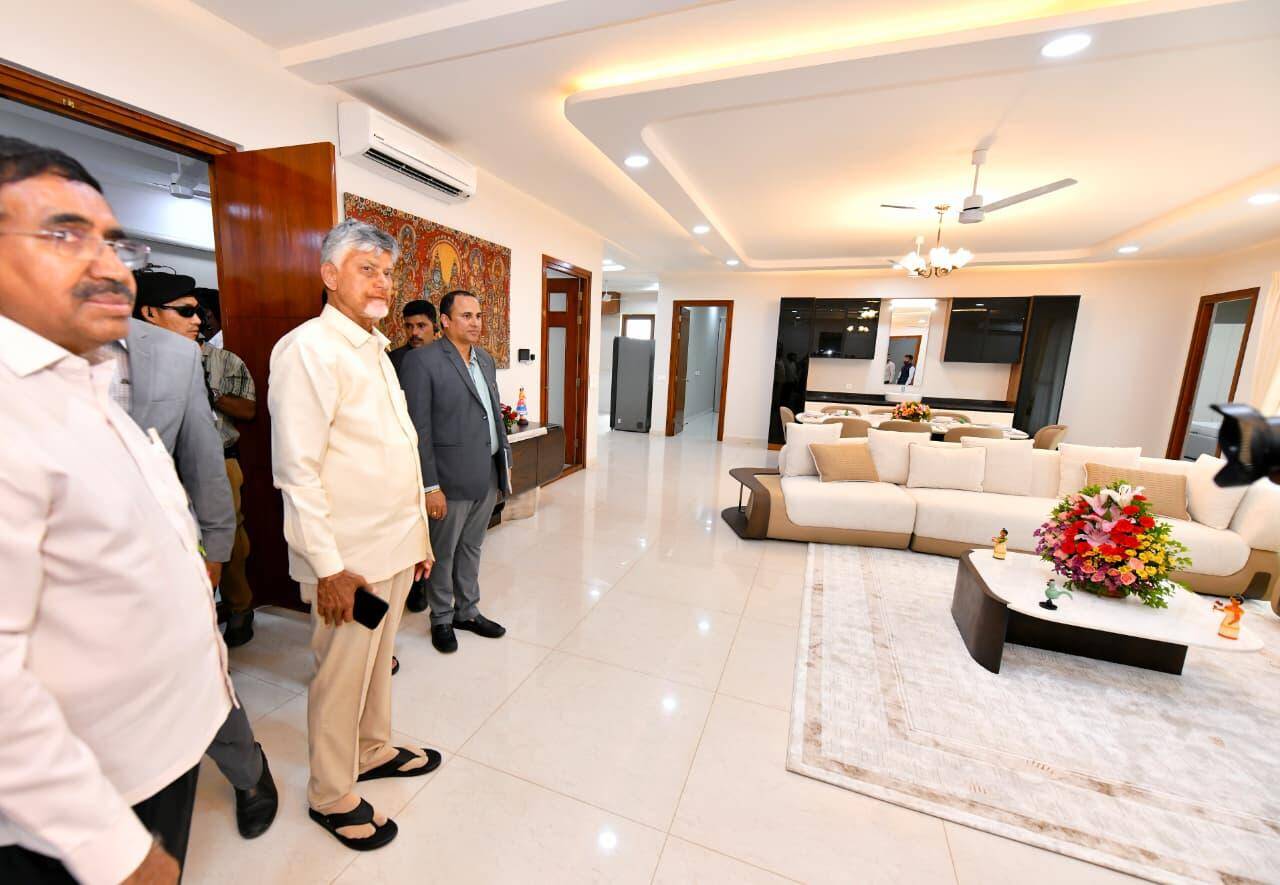
Chief minister Chandrababu Naidu inspects the MLAs and MLCs housing complex in Amaravati on Thursday
Describing the seed access road as the ‘Rajamargam’ (grand avenue) to Amaravati, he said it marks only the beginning of the capital’s physical transformation. “In its third phase, the road would connect with the national highway at Tadepalli. The Centre has also approved a 96-km inner ring road and a 190-km outer ring road for the capital region. The city is being planned with underground utility ducts for water supply, drainage, floodwater management, water treatment, electricity and communication networks. Power cables will not be visible along the roads,” the chief minister added.A district cooling system is expected to reduce energy wastage by around 20%, while piped natural gas (PNG) supply would reduce dependence on LPG cylinders. Water security is another key component of the capital’s infrastructure plan, Naidu said, adding that Amaravati would have assured water availability, with the Krishna on one side and Godavari water brought through gravity flow on the other.He said the Pattiseema project had emerged as a major safeguard for Andhra Pradesh during difficult weather conditions, and reiterated that the govt would complete the Polavaram project by next year.Recalling the origins of Amaravati, Naidu said the bifurcation of Andhra Pradesh had left the state without a capital and that Guntur district’s central location among the state’s 25 parliamentary constituencies had influenced the decision to establish the capital there. Paying tribute to the farmers who contributed their land for Amaravati’s development, he said their sacrifice would remain an integral part of the capital’s history.Naidu said Singapore had assisted in preparing Amaravati’s master plan, while architect Norman Foster had been engaged to design the administrative complex. Responding to criticism that Amaravati existed only in “graphics”, he said the transformation was now becoming visible on the ground.“The proposed capital region will encompass Amaravati, Mangalagiri, Tadepalli, Guntur, and Vijayawada, along with 10 other municipalities,” he asserted. Describing Amaravati as “unstoppable”, Naidu said the capital would eventually evolve into an economic powerhouse and play a key role in achieving the govt’s vision of ‘Swarna Andhra’ by 2047.