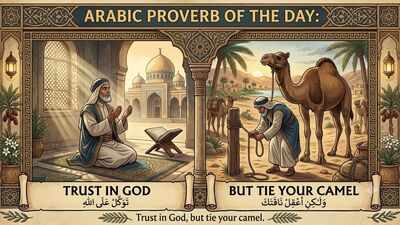
A man once left his camel untied, explaining that he was trusting God to keep it safe. The reply he received became one of the most quietly practical pieces of wisdom ever spoken. Trust in God, he was told, but tie your camel. In other words, by all means have faith, but do not forget to do your own part too. The saying captures a balance that is surprisingly easy to get wrong. Some people rely so completely on fate, luck or a higher power that they neglect the obvious, sensible steps right in front of them. Others work themselves into exhaustion trying to control every last detail, unable to trust anything they cannot personally manage. This proverb gently corrects both. It says that faith and effort are not rivals at all. You tie the camel, doing everything within your power, and then you trust the rest to God. Do your part, and let go of what you cannot control.
Arabic proverb of the day
“Trust in God, but tie your camel.”
Where the proverb comes from
The saying is an Arab proverb, and it comes from a well known story in Islamic tradition. According to a hadith, a record of the sayings of the Prophet Muhammad collected by the ninth century scholar al-Tirmidhi, a man asked whether he should tie his camel and trust in God, or leave it loose and trust in God. The Prophet’s answer was simple and direct: tie it, and then trust in God.In Islam, the idea of trusting in God’s plan is known as tawakkul. This story is often used to explain that tawakkul does not mean sitting back and doing nothing. It means making your best effort first, and then placing the outcome in God’s hands. The lesson has since travelled far beyond its origins, because the wisdom inside it speaks to almost everyone, whatever they believe.
What is the meaning of the proverb
The meaning turns on the two halves of the sentence working together. Trust in God stands for faith, hope, and a calm acceptance that not everything is in our hands. Tie your camel stands for effort, common sense, and taking responsibility for what is in our hands. The proverb insists on both at the same time.Faith without effort can become an excuse for laziness or carelessness. You cannot leave your camel loose and then blame fate when it wanders off. But effort without trust becomes endless anxiety, the exhausting belief that everything depends on you alone. The wise path, the proverb suggests, runs down the middle. Do everything you reasonably can, and then let go of the worry about what you cannot control.
Why this proverb is relevant
Most of us lean too far one way or the other. Some people hope or wish for good outcomes without taking the practical steps that would actually help, then feel let down when things go wrong. Others cannot relax at all, lying awake trying to control situations that are simply beyond them.This little saying speaks to both. It is also strikingly universal. You do not have to be religious to feel its truth. Replace trust in God with trust in the process, or in life, or simply in the things you cannot change, and the advice still holds. Do your part properly, then stop torturing yourself over the rest. That balance is as useful in a modern office as it ever was in the desert.
How to apply this proverb in daily life
You do not need a camel to put this to work. It applies to almost any worry or task.
- Take the sensible step first. Before you hope for the best, ask what practical action is within your power, and do it. Tie the camel before you trust.
- Do not use faith or hope as an excuse. Trusting that things will work out is no substitute for the effort that helps them work out. Pair every hope with an action.
- Then genuinely let go. Once you have done what you can, release the worry. Endlessly fretting over what is now out of your hands changes nothing and only costs you your peace.
- Know the line between the two. Much of wisdom is telling apart what you can control from what you cannot, then working hard on the first and trusting the second.
The same idea across the centuries
The balance this proverb describes is so basic to human life that many cultures arrived at it independently. The English have a plain version in the saying that God helps those who help themselves, the idea that effort and good fortune work together. Long before that, the ancient Greek physician Hippocrates wrote that prayer is good, but a person calling on the gods should also lend a hand himself.There is even an old sailor’s proverb that advises us to call on God, but row away from the rocks. Different languages, different centuries, and yet the same conclusion each time. Ask for help and have faith, by all means, but keep working the oars yourself.The charm of this proverb is that it refuses to choose between faith and effort, and quietly insists we need both. Pure trust without action is naive, and pure effort without trust is exhausting. Real wisdom, it suggests, is doing everything you can and then making peace with everything you cannot. So whatever your version of the camel happens to be today, the advice is the same. Tie it up carefully first. Then, and only then, let yourself trust.