
Happy birthday to the market that has seen it all — bull runs, bear markets, blockbuster wins and brutal bloodbaths.Today, the Bombay Stock Exchange (BSE), home to the sensex and the heartbeat of India’s stock market, turns 151.The towering BSE building on Dalal Street is a far cry from where the journey began. Long before trading apps, blinking screens and lightning-fast transactions, there were paper ledgers, firm handshakes and shouted bids. A handful of brokers came together to form an association that would go on to shape India’s financial destiny, laying the foundation for one of the world’s oldest and most iconic stock exchanges.Over the last one-and-a-half centuries, the BSE has lived through colonial rule, Independence, wars, economic reforms, financial crises, liberalisation and the digital revolution. It has witnessed roaring bull runs and painful market crashes, survived some of the country’s biggest financial scandals, introduced pioneering products and platforms, and remained at the heart of India’s economic growth through every market cycle.Today, paper ledgers have given way to silent servers, algorithmic trading and transactions completed in microseconds, with millions locking in deals with just a few taps.Yet, despite the remarkable transformation, the exchange continues to serve the same purpose it did 151 years ago — bringing together businesses seeking capital and investors looking to build wealth.
Banyan tree to Dalal Street
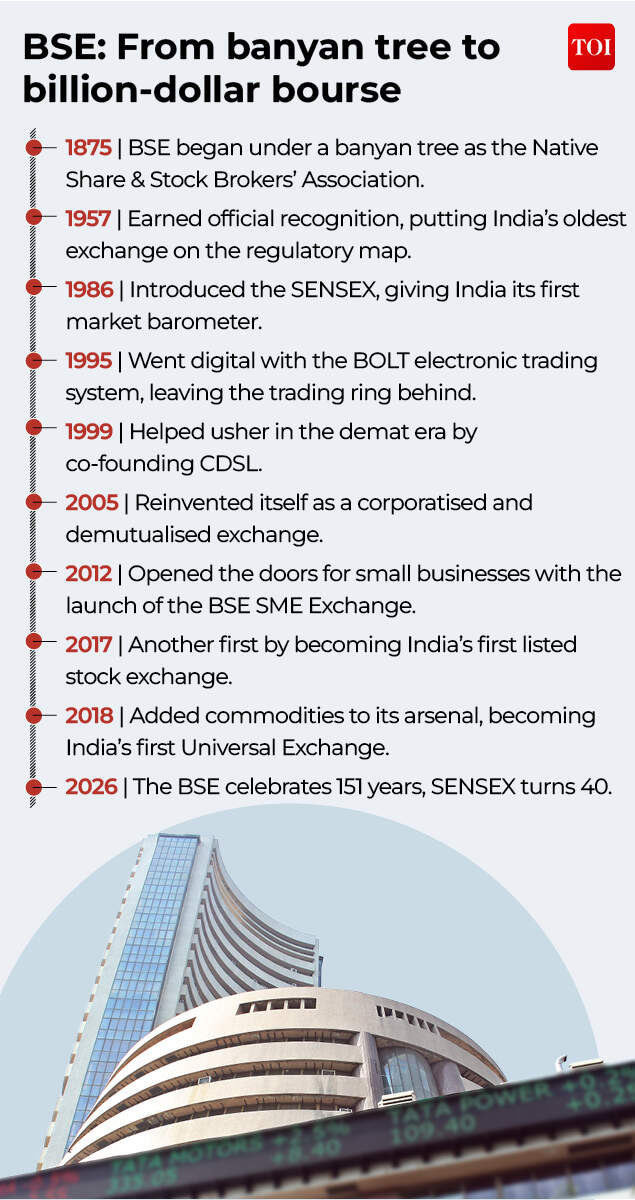
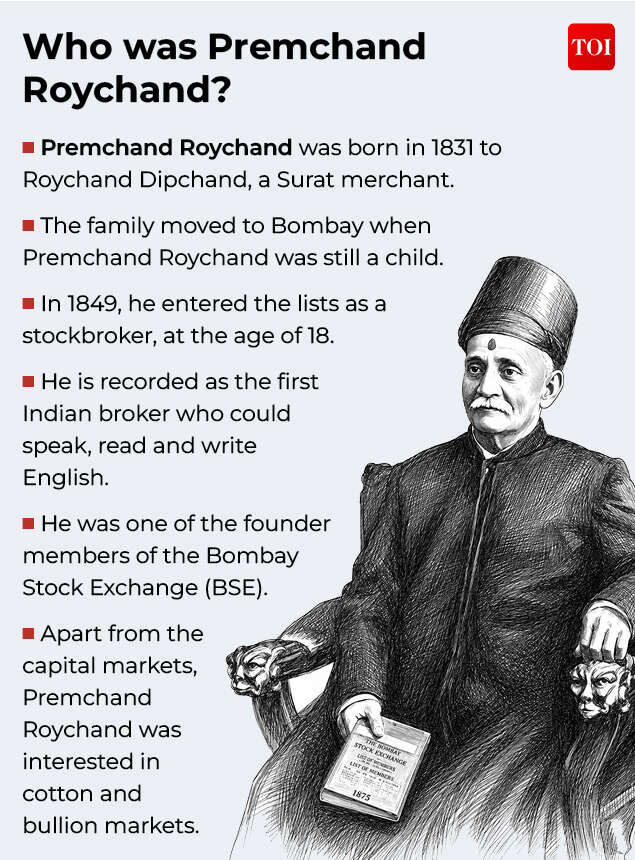
The story began over a century and a half ago with Premchand Roychand, a young broker who would go on to become one of the pioneers of India’s stock market. Along with a handful of fellow brokers, Roychand met beneath the shade of a sprawling banyan tree near Mumbai’s Town Hall, where they traded shares and struck deals.As business gathered pace, the group moved from one location to another before finally settling on a street that would one day become synonymous with India’s financial markets: Dalal Street.What started as an informal gathering soon evolved into a formal institution. On July 9, 1875, the brokers came together to establish The Native Share & Stock Brokers’ Association, laying the foundation for what is now the Bombay Stock Exchange.Back then, there were only a few hundred investors. Deals were struck face-to-face, prices were shouted across the trading floor, and a person’s word carried as much weight as a signed contract.Few could have imagined that this small association would one day grow into one of the world’s oldest stock exchanges, home to thousands of listed companies and trillions of rupees in market capitalisation.
India’s financial capital
The rise of Bombay as India’s commercial nerve centre was no coincidence. Its natural harbour made it one of Asia’s busiest ports, while industries such as cotton, textiles, shipping and banking flourished. As leading business houses, including the Tatas, Birlas, Wadias and Petits, established their presence in the city, the demand for organised financing grew rapidly.The stock market soon emerged as the preferred destination for raising capital. Unlike traditional moneylenders, public markets enabled companies to raise funds from thousands of investors simultaneously, democratising access to capital and laying the foundation for India’s industrial growth.Over time, banks, brokerage houses, insurance companies and financial institutions clustered around the exchange, creating the vibrant financial ecosystem that continues to define Mumbai today.In the decades following Independence, the BSE became a crucial source of funding for India’s industrial expansion. Companies across sectors — including steel, automobiles, engineering, banking, cement, pharmaceuticals and consumer goods — turned to the stock market to finance their growth. Many of today’s corporate giants raised capital through their BSE listings, underscoring the exchange’s role in shaping modern Indian industry.While public participation in equity markets remained relatively limited in the early decades, largely restricted to wealthy families, institutional investors and business communities, the exchange played an indispensable role in financing the nation’s post-Independence development. Every successful public issue translated into factories being built, jobs being created and industries expanding.In many ways, the history of India’s corporate growth is inseparable from the history of the BSE.
From Native Share & Stock Brokers’ Association to BSE
For decades, the Native Share & Stock Brokers’ Association functioned as a self-regulated body. The absence of formal regulation meant trading practices varied significantly. While this flexibility allowed markets to grow, it also exposed investors to manipulation and speculative excesses.As the country’s financial system matured, the need for legal recognition became increasingly apparent.A major milestone came in 1957, when the government granted permanent recognition to the Bombay Stock Exchange under the Securities Contracts (Regulation) Act.The recognition transformed BSE into India’s first officially recognised stock exchange.It also laid the foundation for a more transparent and regulated securities market. The move strengthened investor confidence and encouraged more companies to access public capital.
BSE gets a baby
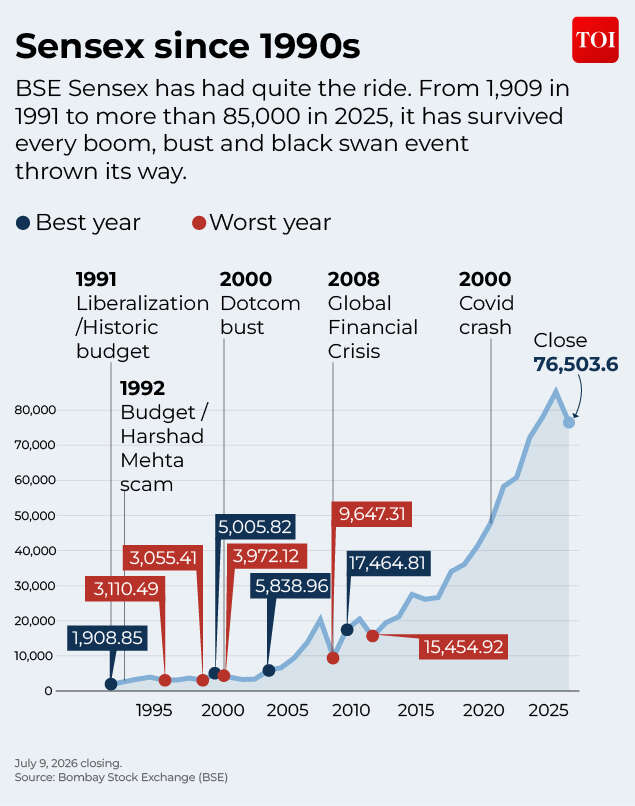
Launched on January 2, 1986, India’s first benchmark equity index, the sensex, transformed the way traders tracked the stock market, becoming the daily pulse of Dalal Street.Designed to capture the performance of 30 of the largest, most liquid and financially sound companies listed on the BSE, the index offered investors a snapshot of the Indian economy in a single number.With a base year of 1978–79 and a base value of 100, the sensex has since climbed from double digits to five figures, mirroring India’s economic journey along the way. Over the decades, the index has become far more than just a market gauge. A rising sensex has come to symbolise optimism, economic growth and investor confidence, while a falling one often signals caution, uncertainty or global headwinds.Even as newer benchmarks have emerged, the sensex continues to be one of the world’s most closely watched stock market indices and, for millions of Indians, the first number they look for when the markets open.
Liberalisation changes everything
For much of its early history, the country’s economy operated under the tightly controlled Licence Raj, with industrial licensing, capital controls and limited foreign investment restricting business growth.That changed in 1991, when Prime Minister PV Narasimha Rao and finance minister Manmohan Singh launched sweeping economic reforms that opened the economy to private and foreign investment.The impact on India’s capital markets was immediate. Companies increasingly turned to public markets to raise funds, foreign institutional investors poured in, trading volumes surged and the BSE entered one of the most dynamic phases in its history.But the boom also exposed cracks in the financial system.In 1992, stockbroker Harshad Mehta exploited loopholes in the banking system to divert funds into the stock market, driving the sensex from around 1,000 points to nearly 4,500 before the scam unravelled.The crash that followed wiped out investor wealth and severely dented market confidence.The crisis, however, became a turning point.It accelerated reforms, strengthened market oversight and led to the Securities and Exchange Board of India being granted statutory powers in 1992. Many of today’s disclosure rules, surveillance systems and risk-management practices stem from the reforms introduced in the aftermath of the scam.
From paper to red-and-green screens
Until the mid-1990s, trading on Dalal Street was a noisy, paper-driven affair. Orders were executed through open outcry, dealers shouted prices across the trading floor, trades were recorded by hand and settlements often took weeks. As trading volumes grew, the manual system struggled to keep pace.A major turning point came on March 14, 1995, when the BSE launched the BSE On-Line Trading system, or BOLT, ushering in the era of electronic trading. For the first time, buy and sell orders were matched electronically, making transactions faster, more accurate and far more transparent.As BOLT expanded nationwide, brokers no longer needed to be physically present on Dalal Street, transforming the BSE from a Mumbai-based exchange into a truly national marketplace.Technology was accompanied by stronger market safeguards. The BSE introduced investor protection funds, trade guarantee mechanisms and more robust risk-management systems.By the turn of the millennium, the BSE had evolved from a bustling trading floor into a modern electronic exchange capable of processing millions of transactions every day, laying the foundation for India’s next phase of technology-driven and retail-led investing.
Bombay Stock Exchange after 151 years
From a handful of brokers gathering under a banyan tree in 1875 to becoming one of the world’s largest and most influential stock exchanges, the journey of the Bombay Stock Exchange is a reflection of India’s own economic transformation.What began as a small trading association on Dalal Street has today grown into a financial powerhouse, connecting millions of investors with thousands of businesses.Today, BSE lists more than 5,000 companies with a combined market capitalisation of over Rs 470 lakh crore, making it one of the largest exchanges globally by the number of listed firms. From the days of handwritten trades to a world of high-speed digital transactions, the exchange has continuously evolved, offering investors opportunities across equities, mutual funds, debt securities, currencies, derivatives and exchange-traded funds.Even today, the BSE bull occasionally gets a little nervous. Geopolitical tensions, rising oil prices, global uncertainty and sudden market shocks can still make the road ahead a little slippery.Yet, through every storm and market swing, the exchange has continued to evolve, adapt and keep India’s financial engine moving.Beyond numbers, charts and trading screens, the BSE’s biggest achievement lies in the ecosystem it has helped build. It has given investors a platform to participate in India’s growth story, helped businesses raise capital and stood as a silent partner in the country’s economic journey for more than 150 years.