
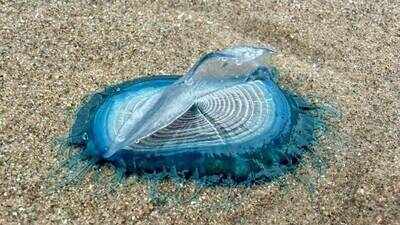
Hundreds of exotic-looking marine creatures known as “by-the-wind sailors” washed up along a beach in northwest England after persistent westerly winds pushed them ashore, prompting warnings from wildlife experts not to touch them because of their painful sting.The unusual sight was reported at St Bees beach in Cumbria, where beachgoers stopped to photograph the striking blue creatures scattered across the shoreline.Local resident Louise Nicholson said she initially mistook them for seaweed.“There were hundreds of them and there were lots of visitors to the area taking photos,” she told the BBC. “They are absolutely beautiful, only about 2ins (5cm) in size. It was a great find on a beautiful day.”
Not jellyfish, but close relatives of Portuguese man o’ war
The Cumbria Wildlife Trust explained that despite their jellyfish-like appearance, the creatures are not jellyfish but are closely related to the Portuguese man o’ war.“Despite appearances, this weird and wonderful creature is not a jellyfish! They’re sometimes found washed up on our shores after westerly winds. Look but don’t touch – they give a very nasty sting,” the trust said.The trust added that the creatures spend their lives drifting across the ocean, propelled by a translucent sail that catches the wind.“As the romantic name suggests, they spend their lives drifting on the wind. Each sailor is a colony of polyps working as a single entity, with different kinds of polyps having different functions, like feeding, reproduction and defence,” it said.
Experts explain why they wash ashore in large numbers
Known for their distinctive blue colour and tiny sail-like structure, the organisms use stinging tentacles to catch young fish.According to the trust, by-the-wind sailors can wash ashore in their hundreds or even thousands after stormy weather and prolonged onshore winds, although they are generally considered harmless to humans if left untouched.Georgia de Jong Cleyndert, the trust’s head of marine, described the creatures as “incredible” and clarified that they are actually colonial hydrozoans—tiny predatory animals rather than jellyfish.“When conditions are right, particularly after periods of persistent onshore winds, thousands can be washed up along our shores,” she said.