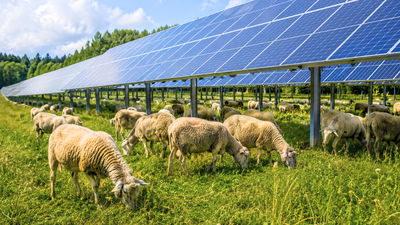
Across Massachusetts, an unusual partnership is bringing renewable energy and traditional farming together on the same land. Sheep are being brought onto ground-mounted solar farms, where the panels provide shade while the animals graze on grass and weeds growing beneath and between the arrays. Known as solar grazing, the practice gives solar operators a natural way to manage vegetation in areas that can be difficult or costly to mow mechanically. At the same time, farmers gain access to additional grazing land for their flocks. Instead of forcing agriculture and renewable energy to compete for space, these projects show how sheep and solar panels can potentially share it.
Why Massachusetts solar farms are turning to sheep
Ground-mounted solar farms need regular vegetation management. Grass, weeds and other plants can grow around the panels and supporting infrastructure, potentially making maintenance and access more difficult if they are allowed to become overgrown.Mechanical mowing remains an option, but manoeuvring machinery around rows of panels, mounting structures, cables and other equipment can be complicated and labour-intensive. Depending on how a solar site is designed, some areas beneath and around the panels may also be difficult for conventional mowing equipment to reach.This is where sheep offer an alternative. Their relatively small size allows them to move beneath and between many solar arrays, eating vegetation as they go.
The solar panels provide more than electricity
For the sheep, the relationship can offer benefits too. Solar panels create shaded areas where animals can seek shelter from direct sunlight, particularly during hot weather.The structures also alter conditions immediately beneath and around them. By changing patterns of sunlight, temperature and evaporation, solar panels can create microclimates that differ from those found in completely open fields.Research into agrivoltaics suggests that, under certain conditions, shade from solar panels can help conserve soil moisture. However, the effects vary depending on climate, vegetation, season and the design of the solar installation.For grazing animals, the combination of vegetation and readily available shade can make appropriately designed solar sites useful pasture.
Sheep become living lawnmowers beneath the panels
The concept is remarkably simple. Instead of relying entirely on machinery to cut vegetation, solar operators can work with farmers or specialised grazing businesses to bring sheep onto the land.As the animals eat grass and weeds, they naturally keep vegetation under control. This can reduce the amount of mechanical mowing required and potentially lower fuel use associated with vegetation maintenance.Sheep are particularly suitable for this job because they can navigate relatively tight spaces without the same risks posed by larger livestock. Cattle, for example, may require solar installations specifically designed to accommodate their greater size and strength.Goats can also present challenges because of their tendency to climb and chew, potentially putting solar equipment and wiring at risk. Sheep, when properly managed, are generally considered a practical choice for many conventional ground-mounted solar sites.
The practice has a name: Solar grazing
The arrangement is known as solar grazing, a form of agrivoltaics that combines agricultural activity with solar energy generation.Rather than dedicating a piece of land exclusively to producing electricity, solar grazing allows that same area to continue supporting livestock agriculture.Electricity is generated by the panels above, while sheep graze the vegetation below. In effect, two forms of production take place on the same property.This approach is attracting interest as communities look for ways to expand renewable energy without completely removing agricultural land from productive use.
Farmers can gain access to valuable grazing land
Solar grazing can also create economic opportunities for farmers.Access to suitable pasture can be expensive or limited, particularly in areas where land values are high. Solar sites can provide additional acreage where farmers can graze their animals under managed agreements.In some arrangements, solar developers pay farmers or specialised grazing companies to manage vegetation with their flocks. This changes the traditional relationship in which farmers typically have to pay for access to land.For solar operators, sheep provide a vegetation-management service. For farmers, the same arrangement can provide grazing opportunities and an additional source of income.Longer-term contracts can also offer greater predictability, allowing farmers to plan their flock sizes and businesses around reliable access to grazing sites.
Solar grazing could reduce reliance on machines
One of the potential environmental advantages of solar grazing is a reduced need for frequent mechanical mowing.Petrol or diesel-powered equipment requires fuel and produces emissions. Machinery also creates noise and needs to be carefully operated around expensive solar infrastructure.Sheep perform the same basic vegetation-control function simply by feeding.However, solar grazing does not mean machinery or fossil fuels disappear entirely. Animals may need to be transported between locations, and some sites may still require occasional mechanical maintenance.The more accurate benefit is that managed grazing can reduce reliance on mowing and, depending on the site, other forms of vegetation control.
Sheep can also return nutrients to the soil
While grazing, sheep naturally return organic material to the land through manure, contributing to nutrient cycling within the soil.When carefully managed, grazing can form part of a broader approach to maintaining healthy agricultural land. However, the number of animals and the length of time they spend at a site must be controlled.Too much grazing can damage vegetation and potentially compact soil, meaning sheep cannot simply be released onto solar farms without supervision.Farmers need to manage flock movements, water supplies, fencing and grazing intensity to ensure that both the animals and the land remain healthy.
A modern energy problem meets an ancient farming solution
Solar grazing is striking because the technology above the sheep and the practice taking place beneath them come from completely different eras.Solar photovoltaic panels represent one of the technologies driving the transition towards cleaner electricity. Grazing livestock, meanwhile, is among humanity’s oldest forms of land management.Bringing the two together allows solar farms to become more than places where electricity is generated. Under the right conditions, they can remain part of a working agricultural landscape, providing pasture for livestock while producing renewable power.The Massachusetts examples are part of a broader movement exploring how renewable energy and agriculture can coexist rather than compete for land. The sheep may appear to be simply eating grass in the shade of solar panels, but the idea behind solar grazing addresses a much bigger challenge: finding ways to produce clean electricity while keeping land productive for farmers and agriculture.