
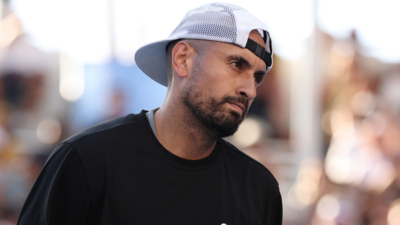
Nick Kyrgios has never had a simple relationship with tennis. The Australian star has spoken openly about depression, self-harm, alcohol and drug use, and a period in 2019 when he was struggling to see a way forward. His family and close friends became an important part of his recovery. That journey later led him to an Australian Open doubles title and the Wimbledon singles final in 2022. But Kyrgios’ story is still unfolding. In August 2026, he was provisionally suspended after testing positive for cocaine, once again putting his mental health and personal struggles in focus.
How did Nick Kyrgios reach his darkest point in 2019
Kyrgios was already a major name in tennis when he began struggling badly with his mental health. His breakthrough had come at Wimbledon in 2014, when the 19-year-old wildcard beat Rafael Nadal in one of the biggest wins of his young career.The attention grew quickly after that. Kyrgios became known for his huge serve, unusual shot-making and emotional behaviour on court. He was also under constant pressure to live up to his talent.By 2019, he said he was not coping well with that pressure. In an interview later published about his struggles, Kyrgios described that period as one of the lowest points of his life.“2019 was the lowest point of my career. That pressure, having all eyes on you, the expectation, I couldn’t deal with it.”He also spoke about drinking, drug use, pushing away people close to him and hurting himself. After losing at Wimbledon that year, he returned to his hotel and found his father crying beside him. Kyrgios later said that moment made him realise that he could not continue living in the same way.He eventually went to a psychiatric ward in London. He later explained that doctors wanted him to stay for two weeks so his condition could be assessed.For someone who had spent years being seen mainly through his behaviour on a tennis court, admitting how badly he was struggling was a major change.In 2022, Kyrgios also wrote about that period on Instagram, saying he had been lonely, depressed and struggling to get out of bed while still having to play in front of millions of people. The Guardian reported his comments at the time.
How did Nick Kyrgios’ family help him through his mental health battle
Kyrgios has repeatedly spoken about the importance of his family and the people closest to him. His struggles became worse when he began shutting them out, something he later recognised as part of the problem.His father, Giorgos, was with him during the difficult period in 2019. That night after the Wimbledon defeat became especially important because seeing his father break down forced Kyrgios to look at what was happening to him.“I lost at Wimbledon, I woke up and my dad was just sitting next to me on the bed and he was like full-blown crying. That was a bit wake-up call for me. I was like, okay, I cannot keep doing this.”His relationship with his family has remained a major part of how he talks about his life away from tennis.Kyrgios has also spoken about how difficult fame was for his family when his career suddenly took off. In an interview with Ed Mylett, he explained that he and his family came from a quiet area in Canberra and were not wealthy. Success changed their lives quickly, and he said they were not prepared for that level of attention.He also said that spending more time with his family during injury breaks helped him understand how much he had missed them while travelling around the tennis world.That support became even more important as Kyrgios dealt with injuries and the long periods away from competition that followed his biggest season.
How did Nick Kyrgios turn his struggles into tennis success
The clearest sign that Kyrgios had found a better balance came in 2022.He teamed up with his childhood friend Thanasi Kokkinakis at the Australian Open. The pair entered the men’s doubles tournament as wildcards and went on to win the title, beating fellow Australians Matthew Ebden and Max Purcell in the final. It was the first Australian men’s doubles title at the tournament since 1997.Only months later, Kyrgios reached the Wimbledon singles final.That run was one of the biggest achievements of his career. He beat several strong opponents before meeting Novak Djokovic in the final. Kyrgios won the opening set but Djokovic came back to win 4-6, 6-3, 6-4, 7-6(3).The result still marked a major change for Kyrgios. He had gone from speaking publicly about suicidal thoughts and severe mental health struggles to playing in his first Grand Slam singles final.After the final, Kyrgios spoke about the pressure he had felt throughout the tournament.“It’s just a lot mentally. Everyone’s supporting you. There are negative comments. Like the pressure of playing finals at Wimbledon.”He also described the strange feeling of being on Centre Court after everything he had experienced.“I’m just not supposed to be here. Like, I’m a kid from Canberra.”Those words captured why his Wimbledon run meant more than simply reaching a final. It showed how much his life had changed.
What does Nick Kyrgios’ latest setback mean for his journey
Kyrgios’ story cannot be described as a straight line from struggle to recovery. His recent years have included serious injuries, limited time on court and renewed personal difficulties.In August 2026, the International Tennis Integrity Agency provisionally suspended him after he tested positive for cocaine at an ATP tournament in Mallorca in June. The substance found in his sample was benzoylecgonine, a metabolite of cocaine. Kyrgios accepted responsibility and said he had made a “huge mistake”.He linked the episode to the physical and mental strain caused by years of injuries and uncertainty over his tennis future. He also announced a 28-day break from social media and public life to focus on his well-being.That latest chapter does not erase what Kyrgios achieved in 2022, nor does it make his earlier openness about mental health less important. It does, however, show that recovery is not always a straight path.Kyrgios has spent much of his career being judged for what people see on the court. His own accounts have shown that there was always much more happening away from it. His willingness to talk about depression, self-harm, substance use and the role of his family has given fans a different way to understand him.His tennis story includes a Wimbledon final and a Grand Slam doubles title. His personal story is more complicated. It is about asking for help, accepting support, falling back into difficult places and trying to find a way forward again.