
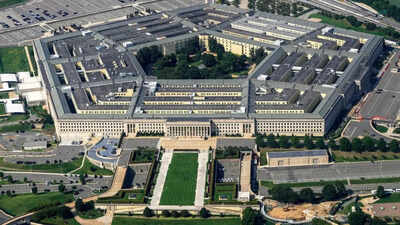
The Pentagon on Monday reinstated and expanded a list of Chinese companies it accuses of supporting China’s military, naming major firms including Alibaba Group Holding, Baidu Inc., Tencent Holdings and electric vehicle maker BYD Co. The move is likely to add further strain to already tense US-China relations.The US Department of Defense said the companies had been added to its so-called 1260H list, which identifies entities determined by Washington to be aiding China’s People’s Liberation Army (PLA). The updated roster largely mirrors a version that briefly appeared in February before being withdrawn within minutes, a reversal that sparked confusion and revealed internal disagreements within the US government.
Companies added to Pentagon’s 1260H list
With the latest update, the Pentagon has formally designated three of China’s most prominent artificial intelligence companies, Alibaba, Baidu and Tencent, as entities supporting China’s armed forces. Tencent was first added to the list in 2025 and has since sought its removal. The inclusion of BYD extends the designation to China’s largest electric vehicle manufacturer.The Pentagon also restored two Chinese memory chipmakers, ChangXin Memory Technologies and Yangtze Memory Technologies, which had previously been listed but were omitted from the short-lived February version.While the 1260H designation carries limited immediate legal consequences, US officials have increasingly used it to restrict companies’ ability to secure contracts with the US military or receive US government research funding. The designation also serves as a warning to American investors and is widely viewed as a potential precursor to stricter trade or technology restrictions.Most of the companies, including Alibaba, Baidu and BYD, did not immediately respond to requests for comment from Bloomberg News. Several have previously rejected US allegations that they support the Chinese military.China’s embassy in Washington did not immediately comment. Previously, embassy spokesman Liu Pengyu urged the United States to correct what Beijing described as “wrong practices” and provide a fair, just and non-discriminatory business environment for Chinese companies.
Decision follows Trump-Xi meeting
The publication of the list comes less than a month after US President Donald Trump met Chinese President Xi Jinping in Beijing, where the two leaders discussed trade disputes between the world’s two largest economies. The meeting failed to produce a significant easing of tensions over advanced technologies, particularly artificial intelligence.“The Pentagon’s republished Chinese military companies list serves as a post-summit reality check,” said Craig Singleton, senior China fellow at the Foundation for Defense of Democracies. He added that the meeting clarified areas where competition between Washington and Beijing would continue.Also added to the list was WuXi AppTec, a pharmaceutical contractor that has worked with many of the world’s largest drugmakers. Bloomberg has reported that, as of 2024, WuXi was producing much of the active ingredient used in Eli Lilly’s obesity drug Zepbound.WuXi said its inclusion was a mistake and argued that it does not meet the statutory criteria for designation. The company added that it is neither controlled by nor affiliated with China’s military or government.Bloomberg News previously reported that the Pentagon’s decision to briefly remove ChangXin and Yangtze Memory Technologies in February prompted objections from White House national security officials, who feared the move could signal a softening US stance ahead of a planned Trump-Xi meeting.Officials also expressed concern that removing the chipmakers could benefit Chinese firms at the expense of US rival Micron Technology and South Korean companies Samsung Electronics and SK Hynix.Following those objections, a senior White House official contacted the Pentagon to express displeasure after the list was published in February, prompting defence officials to withdraw it within minutes, according to Bloomberg.The episode gave affected companies several weeks to pursue lobbying efforts and legal strategies before the revised list was republished in June.Congress first directed the Defense Department to compile a list of Chinese military companies operating in the United States in 1999. However, the Pentagon only began publishing such a roster more than two decades later following renewed pressure from lawmakers and the first Trump administration.US officials have cited China’s “military-civil fusion” policy, which mandates cooperation between private companies and the armed forces, as justification for the designations.The latest update is among the most significant in the list’s history, targeting nearly 200 companies, many of them among China’s most prominent firms.Former Trump White House official John McEntee, who now lobbies for Tencent, criticised the company’s continued inclusion, saying the logic behind the designations would imply that US automakers such as Ford and General Motors should also be considered military companies.The updated list also included China-based TP-Link Technologies, prompting confusion because California-headquartered TP-Link Systems, which has separately faced scrutiny in the United States, is not covered by the designation.A company spokesperson said TP-Link Systems is not subject to the list or any of its restrictions.