
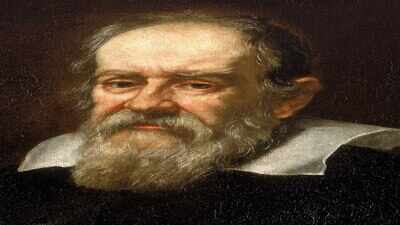
Two people can look up at the same familiar Moon and experience it in completely different ways. One sees a flat, silver disk, a fixture of the night sky glanced at and forgotten a thousand times before. The other looks at the exact same object through a new instrument and sees, for the first time, an actual place, with mountains, valleys, and shadow, close enough almost to walk on. Galileo Galilei had that second experience in the autumn of 1609, and he made sure the rest of the world understood what had changed. “It is a beautiful and delightful sight to behold the body of the Moon,” he wrote, describing an object everyone had already seen as though he were the first person to actually look at it.
Quote of the day by Galileo Galilei
“It is a beautiful and delightful sight to behold the body of the Moon.”
What Galileo Galilei actually meant
He was not describing a poetic impression or a vague feeling of wonder at the night sky in general. His point was specific and almost clinical in its excitement. Through his improved telescope, the Moon had stopped being a smooth, mysterious disc and had become something closely resembling terrain, uneven, textured, full of the same kinds of features found on Earth. What he was calling beautiful was not the Moon as a symbol, but the Moon as newly visible fact.Two observers standing side by side, one looking with the naked eye and one looking through Galileo’s telescope, would have described the same object in almost unrecognisably different terms. One saw a familiar light in the sky. The other saw craters, shadows cast by mountain ranges, and a rough, uneven surface that directly contradicted centuries of accepted belief that celestial bodies were perfect, smooth spheres. Galileo’s delight was not aesthetic appreciation layered on top of old knowledge. It was the specific pleasure of watching an old assumption dissolve in real time.
Written in the pamphlet that changed what looking meant
What gives this line extra weight is exactly where it appeared. Galileo published it in Sidereus Nuncius, or The Starry Messenger, a short pamphlet released in Venice in 1610 that reported, for the first time in print, what his improved telescope had revealed: the rough terrain of the Moon, four moons orbiting Jupiter, and vastly more stars than were visible to the naked eye. The book moved quickly through the scientific circles of Europe, in large part because it did something almost nobody else’s work had done: it invited readers to look for themselves, rather than simply take the author’s authority on faith.That invitation was not universally welcomed. Some of the most established philosophers of Galileo’s era refused outright to even look through the telescope, dismissing the request as beneath serious consideration, a resistance Galileo found so absurd he complained about it directly to fellow astronomer Johannes Kepler. The delight in this quote reads differently against that backdrop. Galileo was not merely admiring the Moon. He was quietly, almost defiantly, insisting that direct observation deserved more trust than inherited authority, at a moment when saying so out loud carried real professional and eventually personal risk.
Why this idea keeps coming back
The basic experience in this quote, an ordinary, familiar object transformed by a new way of looking at it, echoes throughout the history of scientific instruments, from the first users of the microscope discovering an entire invisible world in a drop of water, to modern astronomers encountering deep-field images that reveal galaxies where earlier telescopes showed only empty black sky.Galileo was describing, in one of the earliest and most consequential instances, something that keeps recurring wherever a new instrument extends human perception past its natural limits. That pattern is a large part of why this quote still gets cited well outside the history of astronomy. It is not describing a personal reaction unique to one man’s telescope. It is describing what happens, reliably, whenever a tool lets people actually see something they had previously only assumed.
A simple way to actually use this idea in daily life
The useful move here is treating familiar things as worth a second, closer look before assuming there’s nothing left to discover in them, since the object itself doesn’t need to change for a person’s understanding of it to change completely.A fair test is to ask, of something looked at a thousand times without much thought, what a slightly closer or more careful look might actually reveal. That question won’t turn every familiar object into a discovery. It usually reveals how much genuine looking gets skipped simply because something feels too familiar to bother with.
Other famous quotes by Galileo Galilei
- “And yet it moves.”
- “The surface of the Moon is not smooth, uniform, and precisely spherical… but is uneven, rough, and full of cavities and prominences.”
- “In the sciences, the authority of thousands of opinions is not worth as much as one tiny spark of reason in an individual man.”