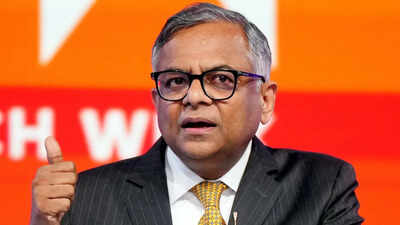
Tata Sons chairman N Chandrasekaran has discussed with close associates the possibility of stepping down amid uncertainty over his continuation on the board of Tata Sons, according to a report by The Economic Times.Chandrasekaran’s current term as chairman runs until February 2027, but his continuation depends on his reappointment as a director at the company’s annual general meeting (AGM) scheduled for August 18.With the AGM less than a week away, uncertainty remains over whether the meeting can be held and how Tata Trusts, which have a majority ownership in Tata Sons, will vote.The immediate issue centres on the status of the Sir Ratan Tata Trust (SRTT), which has been suspended from taking decisions by the Maharashtra charity commissioner pending an inquiry into alleged violations of the Maharashtra Charitable Trusts Act.According to the report, Tata Sons’ Articles of Association provide for trustees jointly nominated by SRTT and Sir Dorabji Tata Trust, which together are the majority owners of Tata Sons, to vote at the AGM.With SRTT currently barred from decision-making, questions have emerged over whether it can nominate trustees to participate in the August 18 meeting without explicit permission from the charity commissioner.Some SRTT trustees, including Noel Tata, Darius Khambata and Jehangir Jehangir, have sought permission from the Maharashtra charity commissioner to participate in the AGM, arguing that their attendance is necessary to protect the trust’s interests.Vijay Singh and Venu Srinivasan were not among the signatories to that request.Noel Tata is seen as opposed to Chandrasekaran’s continuation, the report said.The uncertainty over the trusts’ voting position adds another variable to the outcome of the AGM.Under the Companies Act, directors liable to retire by rotation remain in office until the relevant AGM, where shareholders must either reappoint them or fill the vacancy. However, the law does not explicitly spell out what happens when an AGM itself cannot be held because of a lack of quorum.Corporate lawyer Ruchi Khatlawala, partner at Little & Co, told ET that Sections 152(6) and 152(7) of the Companies Act provide the framework for retirement by rotation and deemed reappointment when a vacancy is not filled at an adjourned AGM.“However, the Act does not expressly extend the tenure of a retiring director where the AGM itself cannot be held due to lack of quorum,” she said.In such a situation, she said, the legal position would depend on the company’s Articles of Association and provisions governing adjourned meetings. The company could also have to seek directions from the appropriate authority or court if necessary.The law allows a company to seek deferment of an AGM by up to six months if it cannot hold the meeting.However, whether a director awaiting reappointment can continue during that period would depend on the Registrar of Companies, the company’s Articles of Association and other applicable provisions, according to corporate law specialists cited by ET.The possibility of Chandrasekaran stepping down would mark a significant shift from the position taken by the Tata Trusts about a year ago.The trustees, including Noel Tata, had unanimously resolved around a year ago to recommend another five-year term for Chandrasekaran.However, the Tata Sons board deferred the decision on his reappointment on February 24, 2026, after Tata raised reservations about the performance of the group’s new businesses.Noel Tata was also in favour of giving Chandrasekaran a two-year executive term, in line with the Tata group’s retirement age of 65 for executive roles.Chandrasekaran’s potential departure would therefore create an immediate leadership transition at Tata Sons if the AGM is held and shareholders do not reappoint him as a director.