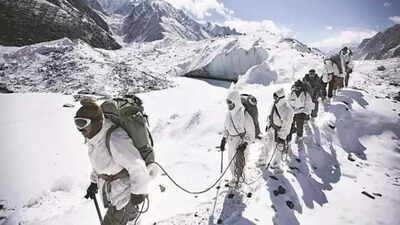
On the 27th of July 1949, after almost an year of deliberation, the Cease Fire Line (CFL), the predecessor of the Line of Control was agreed upon. The line abruptly ended at point NJ9842, the representatives of both the countries left the borders unmarked due to the extreme terrain and high altitudes. The agreement just stated ‘thence north to the glaciers’, for the line to progress to the then unoccupied Tibet. By the late 1970s and early 1980s the Pakistanis started claiming ownership of the area by sending foreign mountaineering expeditions in the area, as well as patrols.In 1984, 35 years after both sides had agreed that the area was unfit for human habitation, India secured the Saltoro ridge overlooking and protecting the Siachen Glacier. A small army team, led by Captain (later Lieutenant General) Sanjay Kulkarni beat the Pakistanis to the top by a matter of days. Two years later, Pakistan’s Special Services Group captured the left shoulder of Bilafond La, establishing Quaid Post at a altitude of 21,500 feet. This dominant position gave Pakistan a strong tactical advantage. This position was named Quaid Post in honour of their nation’s founder Muhammad Ali Jinnah. This post protected by topography, ice, snow and altitude would become the setting for a fierce battle overlooking the world’s highest battlefield.A year later in 1987, 8th Battalion of the Jammu and Kashmir Light Infantry (JAK LI) was ordered to capture this post perched upon the highest point in the area. The Indian battalion occupied two posts named Sonam and Amar on either side of the Pakistani post, with Sonam being the lower the two posts. Both the posts were dominated by this solitary Pakistani post that could rain fire down upon the Indian positions. The vital position for both the nations dominated the entire area for kilometers. Any movement across the desolate, white expanse devoid of any cover could be spotted from Quaid post, which was manned by a group of hand picked men from Pakistan’s elite Special Services Group (SSG).To make matters worse, both Sonam and Amar were accessible only by helicopter. Pakistani fire from their secure perch made the situation difficult both for the soldiers dominated by Quaid and the unarmed helicopters that had to fly on a predictable approach to the small isolated posts, cut off from the rest of the world. The fire also caused casualties to the outgoing 5th battalion of the Bihar Regiment, from whom 8 JAK LI was taking over.The stage was set and the die castThe Siachen Glacier represents the harshest battlefield on earth, with vertical ice walls rising nearly 500 meters, temperatures plunging to minus 60°C, hidden crevasses, avalanches, and cyclone-level winds at altitudes above 20,000 feet. Even seasoned climbers require oxygen and lightweight gear here, yet Indian soldiers faced these conditions with full combat loads. On 29 May 1987, Second Lieutenant Rajiv Pandey led a patrol of 13 men to find a route to the Pakistani-held post dominating the heights. Lance Havildar Mulk Raj Sharma, armed only with an ice axe, painstakingly carved footholds into thick ice, anchoring ropes for others to follow. The team advanced undetected until just 30 meters from the objective, when Pakistani machine guns wiped them out.Brigadier Rajiv Williams, now retired, then a company commander with 8 JAK LI, recalls, “As the patrol moved ahead placing a rope to the top, Havildar Mulk Raj was establishing a path for others to follow. They were fired upon when they were 30 meters away from the Pakistani post resulting in many casualties. Off the 13 men who went to make way to the highest post on the planet, only 2 survived.” The patrol’s sacrifice is an example of the brutal nature of combat in Siachen, where terrain and climate were as deadly as enemy fire. Pandey was posthumously honoured for his courage. For his sacrifice, 2/Lt Rajiv Pandey was awarded the Vir Chakra, India’s third highest wartime gallantry award.8 JAK LI conceived a plan called Operation Rajiv in June 1987, to capture Quaid Post the dominant position at Bilafond La. Named in honour of Second Lieutenant Rajiv Pandey, who had died leading a reconnaissance patrol weeks earlier. Brigadier Rajiv Williams recalled, “The task was entrusted to a force of 55 officers and soldiers, led by Major Varinder Singh. A major effort was undertaken by the newly formed Army Aviation Corps, which undertook a massive effort to assemble the men and equipment.”On 23 June, the force began its arduous climb, slowed by weather and terrain. By 24 June, the assault team located the rope fixed by Pandey’s patrol and prepared for attack. Subedar Harnam Singh led the first attempt at 03:30 AM on 25 June, but weapons jammed in the extreme cold, forcing the assault party to withdraw. Supplies began to dwindle and for 48 hours the men endured sub-zero conditions, surviving on minimal rations and turning to ice as their only source of water. A second attempt under Subedar Sansar Chand also failed, as altitude, the thin air and Pakistani firepower combined forces to repel the attackers.After three nights exposed at 21,000 feet, Major Varinder Singh decided to attack in broad daylight in full view of the enemy with artillery support. At 1:30 PM on 26 June, Naib Subedar Bana Singh led a five-man assault team up a vertical wall to attack the enemy. In brutal hand-to-hand combat, bayonets replaced bullets in the confines of the small post.“The troops who were out in the open for the last three days persevered and won through sheer determination,” Brig Williams noted. Six Pakistani soldiers were killed, and Quaid Post was captured. The perch once captured, was renamed Bana Post, in honour of the leader of the final charge. Bana Singh was awarded the Param Vir Chakra, India’s highest wartime gallantry award, one of only 21 awarded since 1947.Speaking about Operation Rajiv, 39 years later, 77-years-old Honorary Captain Bana Singh said “We did what was best for our country, we were very motivated. We followed the orders that we were given and complete the task”. When asked about the challenges of spending three days out in the open at over 21,000 in bone chilling temperatures and fighting the enemy, the Param Vir Chakra winner said “The Pakistanis fought very hard, our task was difficult, but we were there to do the best for our country and delivered, at that time that’s all we could think of”.Then-SSG Brigade Commander Pervez Musharraf launched Operation Qiadat on 23 September 1987 to wrest the Bilafond La complex from the Indian Army, this included Sonam and Amar posts. India countered with Operation Vajra Shakti, repelling repeated Pakistani assaults with heavy casualties. Brig Williams emphasised, “The credit for this victory goes to the junior leadership men such as 2nd/Lt Sharma of the 3/4 Gurkha Rifles and Subedar Lekh Raj of 8 JAK LI, who fought till his very last.”Musharraf’s failure at Siachen marked his first defeat. A decade later, as Pakistan’s Army Chief, he launched the Kargil War—another misadventure ending in defeat. Kargil was partly intended to pressure India by threatening its road link to Siachen. Operation Rajiv remains a defining moment, showcasing the resilience of Indian soldiers against impossible odds, the importance of junior leadership and the strategic necessity of holding the heights. “The difficult we do immediately. The impossible takes a little longer,” says a signboard in Siachen, summing up the army’s attitude in Siachen.